
PSLE Maths Questions for Singapore Students
Practise original PSLE-style Maths questions, learn common question types, and understand how to approach problem sums step by step.
This guide is built for Singapore primary students and parents who want clearer practice, better worked examples, and a calmer way to revise PSLE Maths.

What types of PSLE Maths questions appear?
PSLE Maths questions are not only about knowing formulas. Many questions test whether a student can read carefully, choose a suitable method, and connect more than one concept.
- Short-answer questions that test accuracy and careful calculation.
- Structured questions that require clear working.
- Word problems with hidden information.
- Multi-step questions involving more than one topic.
- Challenging problem sums that require comparison, units, or model drawing.
How to use this page
Start with the topic cards, then study the worked examples. For each question, ask: what is given, what is unknown, and which relationship connects them?
The questions here are original PSLE-style practice questions, not copied past-year papers.
PSLE Maths questions by topic
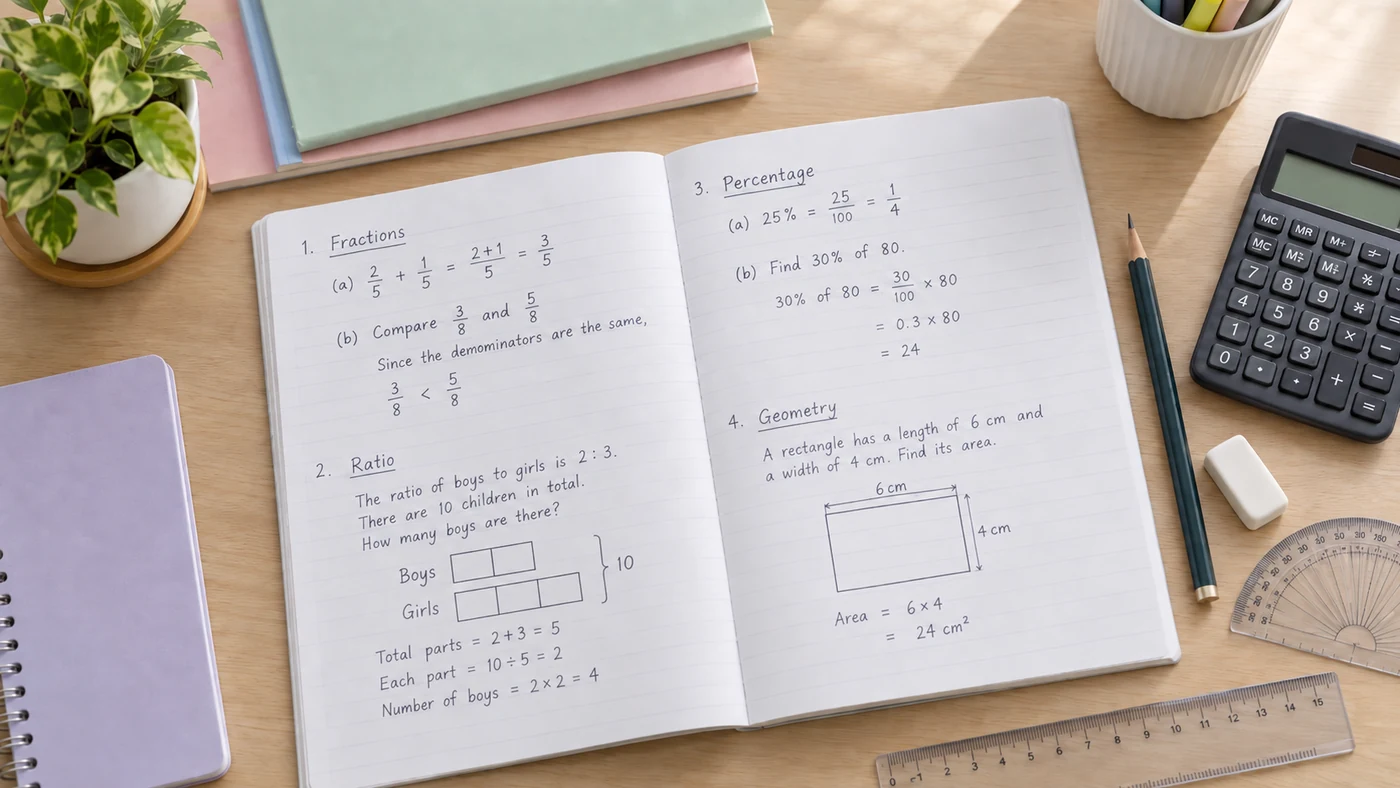
Topic-based practice helps students spot patterns in how questions are asked. Instead of doing random questions, students can revise one skill at a time and build confidence gradually.
Starter PSLE-style worked examples
These starter examples show the basic thinking process before students move on to more challenging PSLE-style practice in the topic resources.
Question
The ratio of the number of blue pens to red pens is 3 : 5. There are 24 blue pens. How many red pens are there?
Solution:
3 units = 24 blue pens
1 unit = 24 ÷ 3 = 8 pens
5 units = 5 × 8 = 40 red pens
Answer: 40 red pens
Common mistake: Some students add 3 and 5 first even though the question already gives the value of the blue pens.
Question
A bag costs $80. During a sale, its price is reduced by 25%. What is the sale price?
Solution:
25% of $80 = 25 ÷ 100 × 80 = $20
Sale price = $80 − $20 = $60
Answer: $60
Common mistake: Do not stop at the discount amount. The question asks for the final sale price.
Question
The average mass of 4 parcels is 6 kg. A fifth parcel is added, and the new average mass becomes 7 kg. What is the mass of the fifth parcel?
Solution:
Total mass of 4 parcels = 4 × 6 = 24 kg
Total mass of 5 parcels = 5 × 7 = 35 kg
Mass of fifth parcel = 35 − 24 = 11 kg
Answer: 11 kg
Common mistake: Students sometimes subtract the averages instead of comparing the total masses.
Difficult PSLE Maths questions
Difficult PSLE-style questions often feel hard because the steps are hidden. The topic itself may not be advanced, but the question may combine comparison, units, diagrams, or changed quantities.
Hidden steps
A question may not tell students directly what to find first. They must identify the missing link before solving.
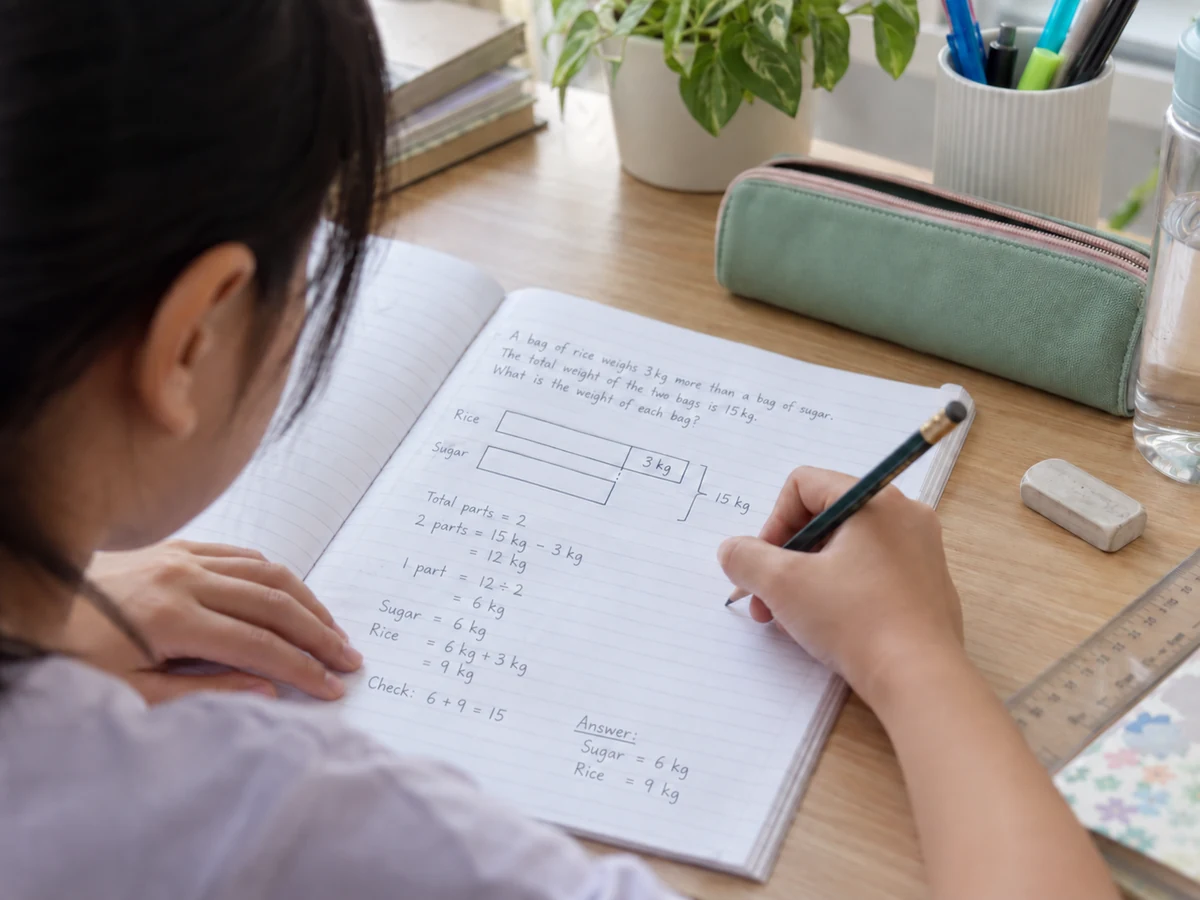
Model drawing
Bar models can help when quantities are compared or when the question involves parts and totals.
Careful reading
Words such as “more than”, “less than”, “remaining” and “altogether” can change the entire meaning.
Problem sums and word problems
Problem sums improve when students learn to translate words into relationships. Before calculating, they should pause and identify the unknown.
- Underline the quantity the question is asking for.
- Circle the information given in the question.
- Draw a model when there is comparison or part-whole information.
- Use units when ratio or repeated groups are involved.
- Check whether the answer makes sense in the story.
A simple problem-sum routine
Read: What is happening in the question?
Represent: Can I draw a model, table or diagram?
Solve: What operation or relationship should I use?
Check: Does my answer fit the question?

How parents can use these questions at home
Parents do not need to reteach every topic. Often, the most useful support is helping a child slow down, explain their thinking, and notice where the confusion begins.
- Ask your child to explain what the question is asking.
- Do not give hints too early.
- Mark the exact step where the mistake happened.
- Revise by question type, not only by chapter.
- Keep a small mistake list for weekly review.
PSLE Maths practice plan
A good practice plan is not about doing as many questions as possible. It should help students strengthen weak topics, revisit mistakes, and practise exam-style thinking.
- 4 weeks before: Revise key topics and identify weak areas.
- 2 weeks before: Practise mixed questions and problem sums.
- Final week: Review mistakes and repeat important question types.
- Day before: Keep revision light and focus on confidence.
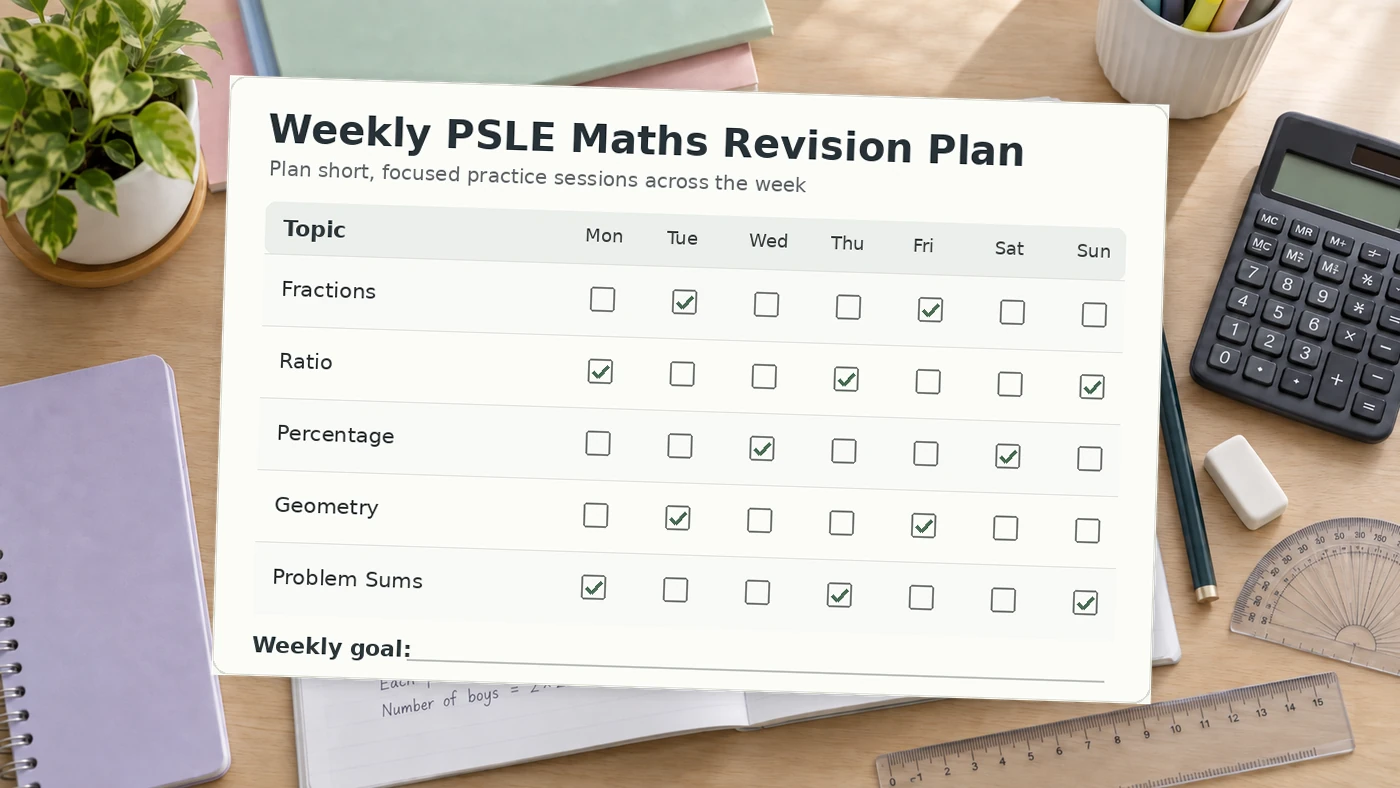
Need help turning PSLE Maths mistakes into a clear revision plan?
If your child keeps getting stuck on problem sums, ratio, fractions, percentage or multi-step questions, structured guidance can help identify the missing concepts and rebuild confidence.
Frequently asked questions
What are the most common PSLE Maths question types?
Common question types include fractions, ratio, percentage, geometry, average, volume, algebra, patterns and multi-step word problems.
How should my child practise PSLE Maths questions?
Practise by topic first, then by mixed question type. After each practice session, review mistakes and repeat similar questions until the method becomes clearer.
Are difficult PSLE Maths questions always from advanced topics?
No. Many difficult questions use familiar topics but combine several steps. The challenge is often in interpreting the question, not in learning a brand-new formula.
Should my child memorise methods for PSLE Maths?
Some methods are useful, but memorising without understanding is risky. Students should know why a method works and when to use it.
How do I help my child with PSLE Maths problem sums?
Ask your child to identify the unknown, list the given information, and draw a model or diagram where helpful. Focus on the thinking process before correcting the calculation.
Is it better to practise by topic or by paper?
Both are useful. Topic practice builds specific skills, while paper practice trains exam stamina and mixed-question thinking. Start with weak topics, then move to timed practice.
Are these questions copied from PSLE past-year papers?
No. The examples on this page are original PSLE-style practice questions. They are designed to teach methods and question types, not to reproduce official exam papers.