
Integers, Rational Numbers and Real Numbers Summary and Review
Revise the key ideas from Chapter 2, including negative numbers, integer operations, fractions, decimals, rational numbers, irrational numbers and real numbers.
This page is designed for students preparing for a class test and teachers who need a structured review lesson with practice questions and answers.
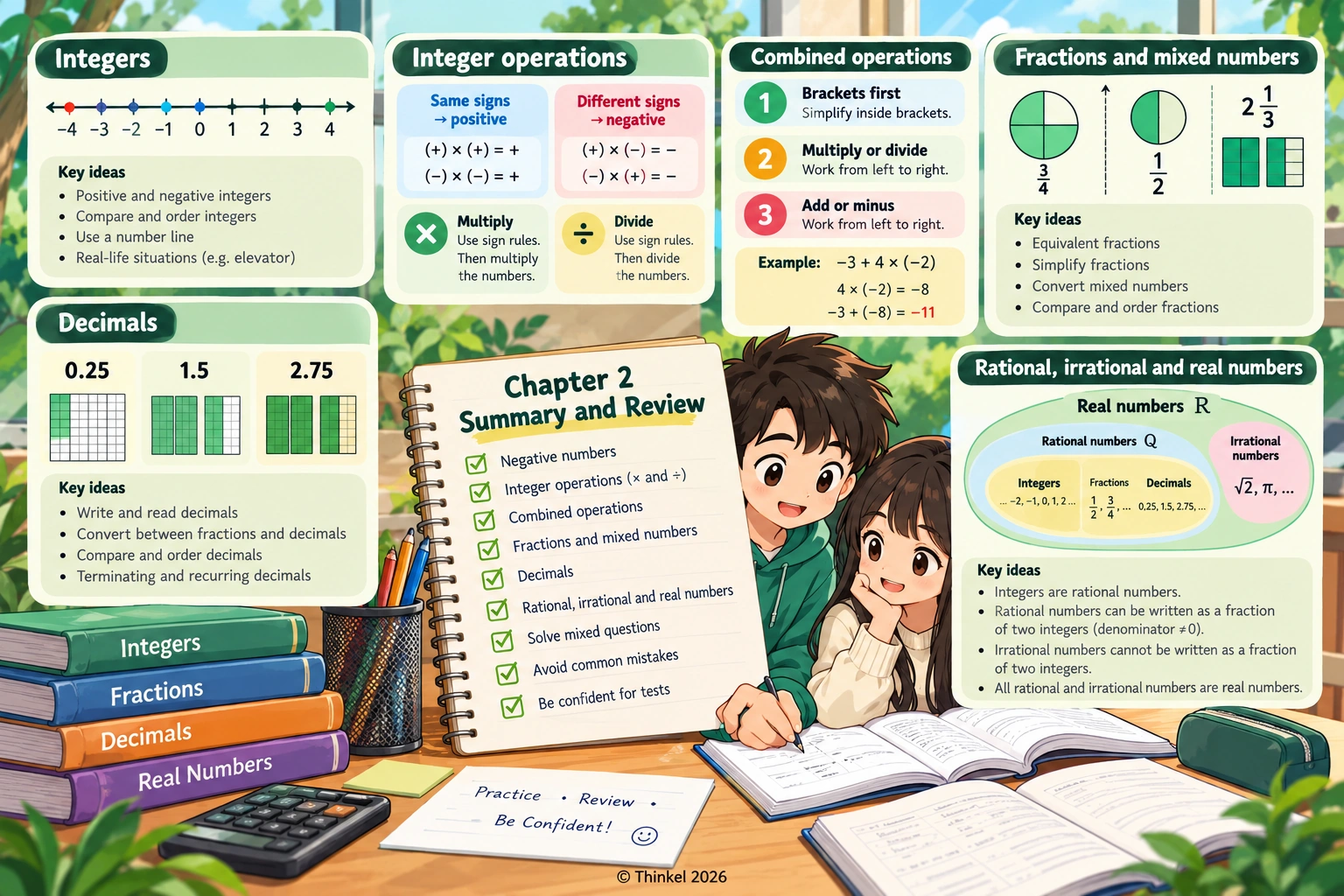
What to revise
By the end of Chapter 2, students should be able to move confidently between number-line ideas, integer operations, fractions, decimals and number types.
Integer operations review
Integer questions test whether students understand direction, sign rules and order of operations.
Add
Adding a positive number moves right or up. Adding a negative number moves left or down.
−4 + 7 = 3
5 + (−8) = −3
Minus
Minus can be pictured as moving down or left.
3 − 8 = −5
−6 − 4 = −10
Multiply and divide
Same signs give a positive answer. Different signs give a negative answer.
−6 × −2 = 12
24 ÷ −3 = −8
Fractions and decimals review
Fractions, mixed numbers and decimals are different ways to show values. Students should be able to convert and compare them.
| Skill | Example | What to remember |
|---|---|---|
| Simplify a fraction | 12/18 = 2/3 | Divide the numerator and denominator by the same common factor. |
| Convert a mixed number | 2 3/5 = 13/5 | Multiply the whole number by the denominator, then add the numerator. |
| Convert decimal to fraction | 0.75 = 75/100 = 3/4 | Use tenths, hundredths or thousandths, then simplify. |
| Convert fraction to decimal | 3/8 = 0.375 | Divide the numerator by the denominator, or convert to a familiar denominator. |
Rational, irrational and real numbers review
Real numbers include rational and irrational numbers. The main task is to recognise how the groups are related.
Integers
Whole numbers, zero and negative whole numbers.
Examples: −3, −1, 0, 4, 12
Rational numbers
Numbers that can be written as a fraction of two integers, where the denominator is not zero.
Examples: −2, 1/2, 0.25, 3
Irrational numbers
Numbers that cannot be written exactly as a fraction of two integers.
Examples: √2, √5, π
Common mistakes to avoid
1. Comparing negative numbers wrongly
Students may think −8 is greater than −3 because 8 is greater than 3.
Correct: −8 is smaller than −3 because −8 is further left on the number line.
2. Forgetting operation order
Students may work from left to right even when multiplication appears after addition.
Correct: −3 + 4 × (−2)
= −3 + (−8)
= −11
3. Misusing sign rules
Students may forget that two negative signs in multiplication or division give a positive answer.
Correct: −6 × −5 = 30
4. Confusing integers and rational numbers
Students may think only fractions are rational numbers.
Correct: −4 is also rational because −4 = −4/1.
Review Exercise questions
Try these questions after revising the chapter summary. They mix the main skills from Chapter 2.
Arrange in ascending order: −4, 2, −7, 0, 5.
Evaluate: −6 + 11
Evaluate: −3 − 8
Evaluate: −7 × 4
Evaluate: −42 ÷ −6
Evaluate: 5 − 3 × (−4)
Evaluate: 24 ÷ (−3) + 2 × 5
Simplify: 15/25
Convert 3 2/7 to an improper fraction.
Convert 0.6 to a fraction in simplest form.
Convert 5/8 to a decimal.
Classify −12 as integer, rational, irrational or real.
Classify √3 as rational or irrational.
Explain why 0.125 is a rational number.
A lift starts at B4. It goes up 9 floors, then down 3 floors. Which level does it reach?
Challenge questions
These questions require students to combine ideas and explain their thinking.
Find the value of −2 × (5 − 9) + 18 ÷ (−3).
Arrange in ascending order: −1.5, 1/2, −2, 0.25, 0.
A number is rational but not an integer. Give two possible examples.
Explain why every integer is a rational number.
Explain why √7 is not a rational number.
Answers and explanations
Use these answers after students have attempted the review exercise and challenge questions.
Review Exercise answers
Challenge answers
Teacher revision notes
Suggested lesson flow
Teacher prompts
Which number is further left on the number line?
Should the final answer be positive or negative?
Which operation must be done first?
Can this number be written as a fraction of two integers?
Is this number an integer, rational number, irrational number or real number?
Chapter 2 complete
Students should now have revised negative numbers, integer operations, fractions, decimals, rational numbers, irrational numbers and real numbers.