
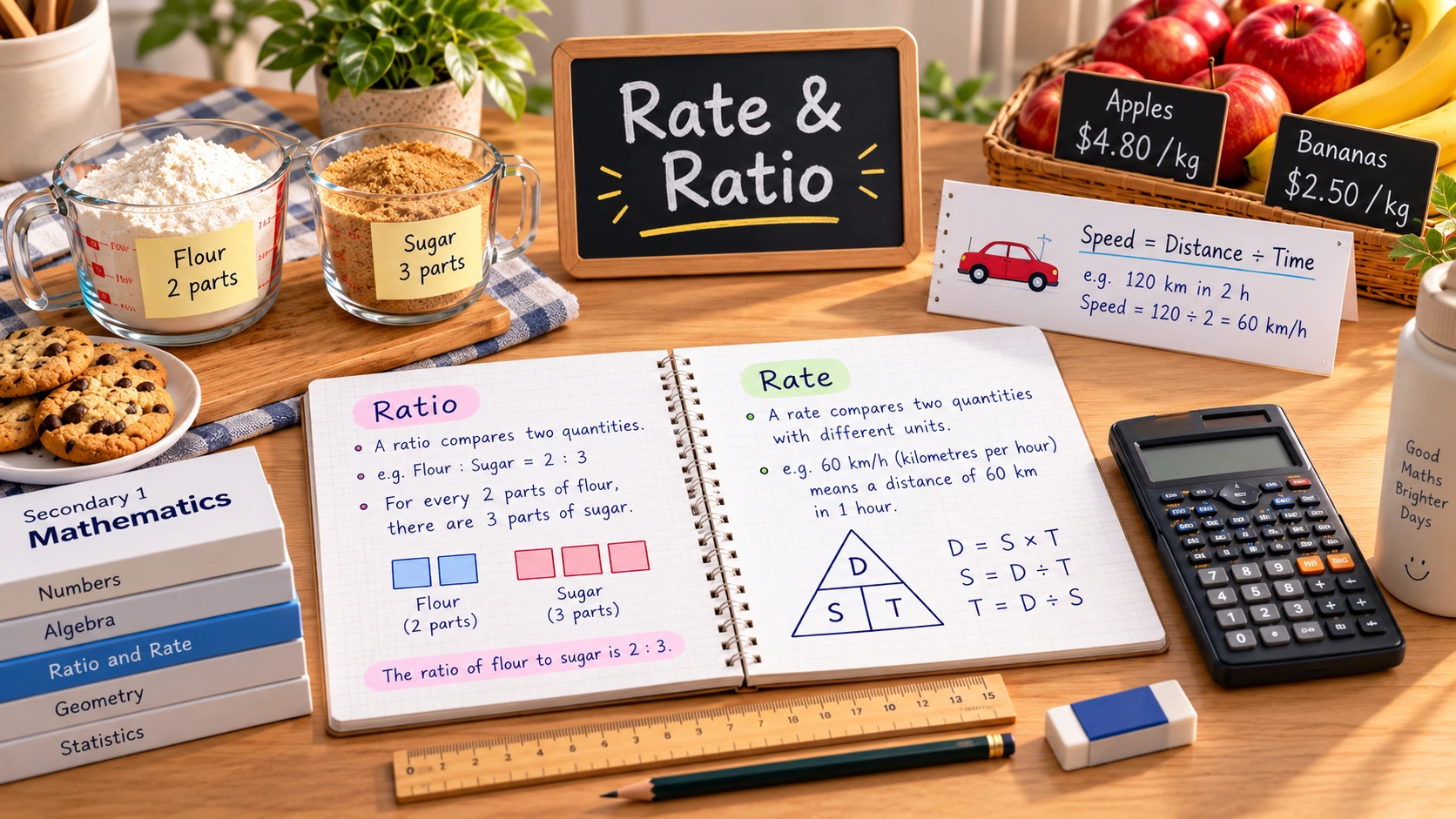
Rate & Ratio
Learn how ratios compare quantities, how rates compare quantities with units, and how speed connects distance and time.
This page supports Sec 1 students with ratio notation, equivalent ratios, unit rates, average rates, average speed, and real-world applications such as currency exchange, interest, hire purchase and tax.
What students should be able to do
Jump to a section
Ratio compares two or more quantities
A ratio is used to compare quantities of the same kind. The order matters. For example, if there are 17 boys and 19 girls, the ratio of boys to girls is 17 : 19, while the ratio of girls to boys is 19 : 17.
| Idea | Example | What to remember |
|---|---|---|
| Ratio notation | boys : girls = 17 : 19 | The first quantity named comes first in the ratio. |
| Part-to-part ratio | red : blue = 3 : 5 | Compares one part with another part. |
| Part-to-whole ratio | red : total = 3 : 8 | Compares one part with the total number of parts. |
| Units in ratio | 600 s : 1.6 min | Convert to the same unit before writing or simplifying the ratio. |
Scale both parts by the same number
Equivalent ratios compare the same relationship. You can multiply or divide every part of the ratio by the same positive number.
Check the parts
Example: 12 : 18.
Find common factor
Both 12 and 18 are divisible by 6.
Simplify
12 : 18 = 2 : 3.
Simplifying ratios
Question: Simplify 0.12 : 0.56.
Multiply both parts by 100:
0.12 : 0.56 = 12 : 56
Divide both parts by 4:
12 : 56 = 3 : 14
Answer: 3 : 14.
Connect ratios using a common quantity
Some questions involve three quantities. When two ratios share a common quantity, make that common quantity equal before combining the ratios.
Example setup
If x : y = 1 : 8 and y : z = 6 : 7, the common quantity is y.
Make the value of y the same in both ratios before combining.
Real-world ratio
Money, ingredients and group sizes often use ratios involving three or more quantities.
Draw a bar model when the relationship is hard to see.
Important: Do not add ratios directly unless the parts refer to the same quantities in the same order.
Rate compares how one quantity changes with another
A rate compares one quantity with another quantity. The quantities can be of the same kind or different kinds. Many rates include units, such as dollars per kilogram, kilometres per hour, or words per minute.
| Type of rate | Example | What it means |
|---|---|---|
| Unit price | $4.80 per kg | The cost for 1 kg. |
| Typing rate | 40 words per minute | The number of words typed in 1 minute. |
| Unemployment rate | 2.1% | A rate comparing unemployed people with the working population. |
| Average rate | total amount ÷ total time | Used when the rate is not constant throughout. |
Compare fairly by finding “per 1”
A unit rate compares a quantity to 1 unit of another quantity. This is useful when comparing prices, speed, typing rates and fuel consumption.
Example: Shop A sells 6 eggs for $1.50. Shop B sells 12 eggs for $2.40.
Shop A: $1.50 ÷ 6 = $0.25 per egg
Shop B: $2.40 ÷ 12 = $0.20 per egg
Better value: Shop B.
Use totals, not simple averaging
Average rate is calculated using the total quantity and total time or total amount. Do not simply average two rates unless the bases are the same.
Trap: If a car travels at different speeds for different parts of a journey, use total distance ÷ total time to find the average speed.
Speed is a special type of rate
Speed tells us how fast an object is moving. It compares distance travelled with time taken.
| Formula | Meaning | Useful reminder |
|---|---|---|
| speed = distance ÷ time | Find how fast something moves. | Use when distance and time are given. |
| distance = speed × time | Find how far something travels. | Use when speed and time are given. |
| time = distance ÷ speed | Find how long the journey takes. | Use when distance and speed are given. |
| average speed = total distance ÷ total time | Find the overall speed for a journey. | Do not average speeds directly. |
Where ratio, rate and speed appear
Chapter 9 connects ratio and rate to everyday applications such as unit price, currency exchange, simple interest, hire purchase, income tax, constant speed and average speed.
Currency exchange
Use exchange rates to convert between Singapore dollars and foreign currencies.
Simple interest
Simple interest depends on principal, rate and time.
Hire purchase
Calculate down payment, instalments and total amount paid.
Income tax
Apply rates carefully based on the correct taxable amount or bracket.
Rate of revolution
Connect circumference, distance travelled and number of revolutions.
Speed algebra
Use variables when distance, speed or time is unknown.
Watch for these mistakes
Changing the ratio order
The ratio of A to B is not the same as the ratio of B to A.
Forgetting unit conversion
Convert cm to m, seconds to minutes, or grams to kg before simplifying if needed.
Averaging speeds directly
Average speed uses total distance ÷ total time, not the average of two speeds.
Comparing rates with different bases
Convert to unit rate first when comparing value for money.
Check readiness before doing the full worksheet
Try these 6 questions first. After clicking Check answers, each question will show a short explanation or trap reminder.
1. Simplify the ratio 18 : 24.
2. Flour : sugar = 2 : 3. If there are 8 parts of flour, how many parts of sugar are there?
3. 6 apples cost $4.80. What is the unit price per apple?
4. A car travels 120 km in 2 hours. What is its speed?
5. A cyclist travels 15 km at 5 km/h. How long does the journey take?
6. A journey has total distance 90 km and total time 3 h. What is the average speed?
Core examples to discuss in class
Example 1. Simplify 2.8 kg : 700 g.
Reveal working
Convert 2.8 kg to grams: 2.8 kg = 2800 g.
2800 : 700 = 4 : 1.
Answer: 4 : 1.
Example 2. A printer prints 72 pages in 9 minutes. Find the printing rate in pages per minute.
Reveal working
Printing rate = 72 ÷ 9 = 8 pages per minute.
Answer: 8 pages/min.
Example 3. A train travels 45 km in 30 minutes. Find its speed in km/h.
Reveal working
30 minutes = 0.5 h.
Speed = 45 ÷ 0.5 = 90 km/h.
Answer: 90 km/h.
Try a few questions before the PDF
These questions are for quick diagnosis. The full worksheet is in the PDF.
1. Simplify 36 : 48.
Reveal answer
36 : 48 = 3 : 4.
2. $7.50 is paid for 3 kg of rice. Find the cost per kg.
Reveal answer
$7.50 ÷ 3 = $2.50 per kg.
3. A runner covers 400 m in 50 s. Find the speed in m/s.
Reveal answer
Speed = 400 ÷ 50 = 8 m/s.
4. A car travels 40 km in 30 minutes and 60 km in 1 hour. Find the average speed for the whole journey.
Reveal answer
Total distance = 40 + 60 = 100 km.
Total time = 0.5 + 1 = 1.5 h.
Average speed = 100 ÷ 1.5 = 66.7 km/h to 3 significant figures.
Use the PDF for the full practice workload
The webpage teaches and diagnoses. The PDF carries the main practice work: ratios, equivalent ratios, unknowns in ratios, rates, unit rates, real-world applications, speed and average speed.
Ratio practice
Includes simplifying ratios, ratio order and unknown quantities.
Rate practice
Includes unit rate, average rate and real-world comparison questions.
Speed practice
Includes speed, distance, time and average speed questions.
Suggested lesson flow
Ready to practise Rate & Ratio?
Download the printable worksheet, check units carefully, and remember that average speed uses total distance divided by total time.
 Stuck? Ask a free tutor