
Integer Operations, Fractions, Decimals and Real Numbers
Learn how to multiply and divide negative integers, handle combined operations, work with fractions and decimals, and understand rational, irrational and real numbers.
This page continues Chapter 2 after negative numbers and integer addition or minus. It is suitable for Secondary 1 students, teachers and guided revision.
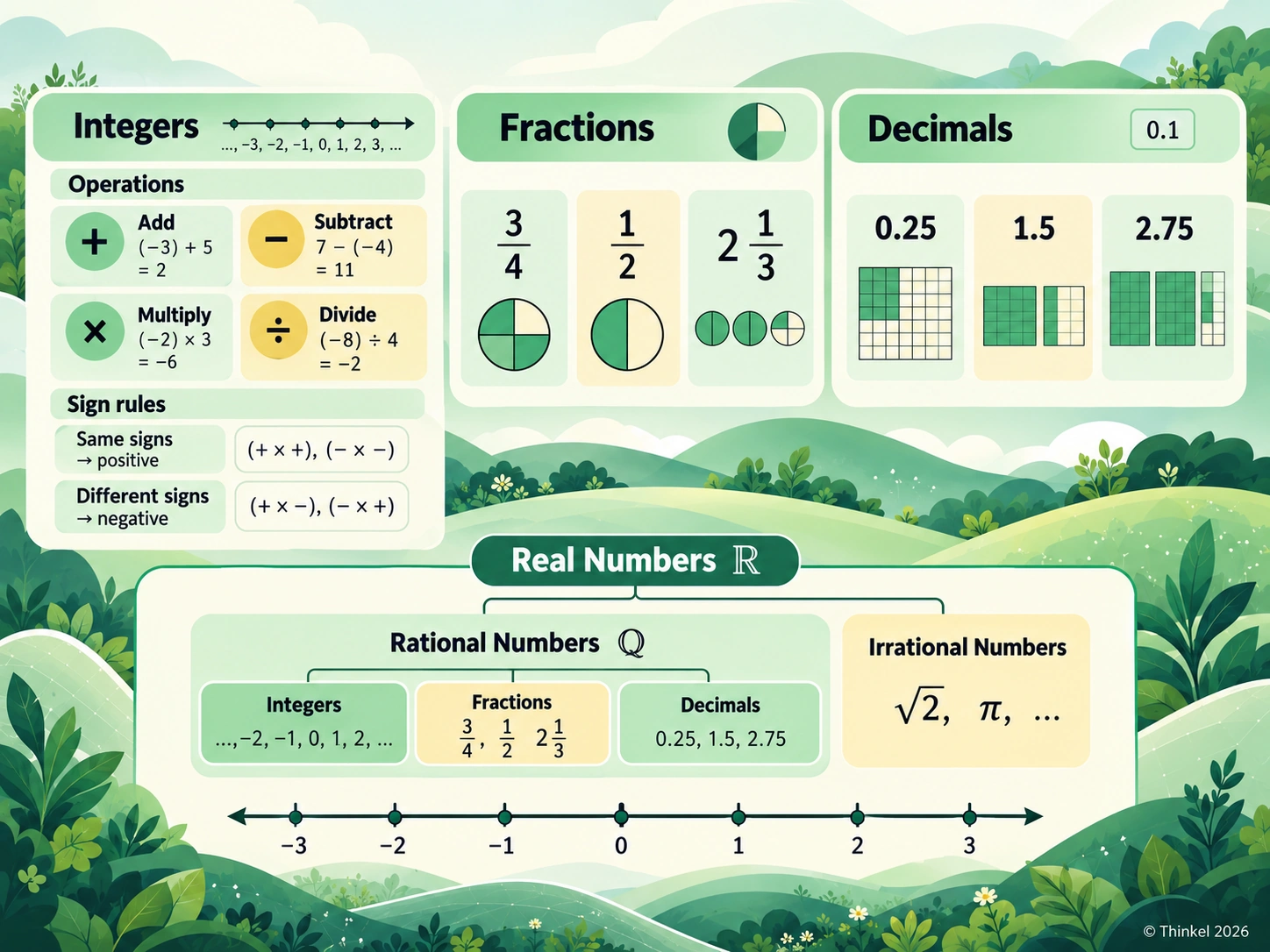
What you will learn
This page focuses on the second part of Chapter 2. Students move from basic integer movement to operation rules, fractions, decimals and number classification.
Multiplying and dividing integers
For multiplication and division of integers, first decide the sign of the answer. Then calculate the number part.
Negative × negative = positive
Negative × positive = negative
Negative ÷ negative = positive
Negative ÷ positive = negative
Worked example 1
Evaluate: −6 × 4
Signs are different, so the answer is negative.
6 × 4 = 24
−6 × 4 = −24
Worked example 2
Evaluate: −35 ÷ −5
Signs are the same, so the answer is positive.
35 ÷ 5 = 7
−35 ÷ −5 = 7
Combined operations
Combined operations include more than one operation in the same expression. Follow the correct order so that everyone gets the same answer.
1. Brackets first
Always simplify inside brackets before working on the rest of the expression.
2. Multiply or divide
Work from left to right when multiplication and division appear together.
3. Add or minus
Work from left to right when addition and minus appear together.
Worked example 3
Evaluate: −3 + 4 × (−2)
Do multiplication first.
4 × (−2) = −8
−3 + (−8) = −11
Answer: −11
Worked example 4
Evaluate: 18 ÷ (−3) − 5
Do division first.
18 ÷ (−3) = −6
−6 − 5 = −11
Answer: −11
Fractions and mixed numbers
A fraction shows part of a whole. A mixed number has a whole-number part and a fraction part.
Fraction examples
3/4 means 3 parts out of 4 equal parts.
1/2 means 1 part out of 2 equal parts.
5/6 means 5 parts out of 6 equal parts.
Mixed number example
2 1/3 means 2 wholes and 1/3.
2 1/3 = 7/3
Convert to an improper fraction when it helps with calculation.
| Skill | Example | Reminder |
|---|---|---|
| Simplify fractions | 6/8 = 3/4 | Divide numerator and denominator by the same number. |
| Convert mixed number | 1 2/5 = 7/5 | Multiply the whole number by the denominator, then add the numerator. |
| Compare fractions | 2/3 and 3/5 | Use a common denominator when the denominators are different. |
Decimals
Decimals are another way to write parts of a whole. Some decimals stop. Some decimals continue with a repeating pattern.
0.25
0.25 = 25/100 = 1/4
1.5
1.5 = 1 1/2 = 3/2
2.75
2.75 = 2 3/4 = 11/4
Worked example 5
Convert 0.375 to a fraction.
0.375 = 375/1000
375/1000 = 3/8
Answer: 3/8
Worked example 6
Convert 7/20 to a decimal.
7/20 = 35/100
35/100 = 0.35
Answer: 0.35
Rational, irrational and real numbers
Real numbers include rational numbers and irrational numbers. In Sec 1 Maths, students should know how these number types are related.
Rational numbers
A rational number can be written as a fraction of two integers, where the denominator is not zero.
Examples: 3, −5, 1/2, 0.25, 2.75
Irrational numbers
An irrational number cannot be written exactly as a fraction of two integers.
Examples: √2, π
Integer multiplication, division and combined operations
Try these after learning sign rules and order of operations.
Evaluate: −8 × 3
Evaluate: −6 × −7
Evaluate: 45 ÷ −9
Evaluate: −56 ÷ −8
Evaluate: −4 × 5 + 6
Evaluate: 18 ÷ (−3) − 7
Evaluate: −2 × (−6 + 1)
Evaluate: 30 ÷ (−5) + 4 × 2
Evaluate: −3 × −4 − 20 ÷ 5
Evaluate: 5 − 2 × (−7)
Fractions, decimals and real numbers
These questions practise fraction-decimal conversion, mixed numbers and number classification.
Simplify: 12/18
Convert 2 3/5 to an improper fraction.
Convert 0.4 to a fraction in simplest form.
Convert 0.75 to a fraction in simplest form.
Convert 3/8 to a decimal.
Convert 11/4 to a mixed number.
Which of these are integers? −4, 0.5, 7, 3/4, 0
Which of these are rational numbers? −2, 1/3, 0.6, √2, π
Give two examples of irrational numbers.
Explain why 0.25 is a rational number.
Mixed questions
Use these questions to check whether students can combine operation rules with number classification.
Evaluate: −5 × 6 ÷ −3
Evaluate: −12 ÷ 4 + 2 × −5
Evaluate: 7 − 3 × (−2)
Convert 1.25 to a mixed number.
Convert 2 1/4 to a decimal.
Arrange in ascending order: −2, 0.5, −1.5, 1, 0
Classify −9 as integer, rational, irrational or real.
Classify √5 as rational or irrational.
Answers and explanations
Use these answers after students have attempted the questions.
Practice Set 2C answers
Practice Set 2D answers
Mixed practice answers
Teaching notes and common mistakes
Common mistakes
Suggested classroom flow
Next step
After this page, students should consolidate the whole chapter with summary notes and review questions for integers, rational numbers and real numbers.