
Negative Numbers and Integer Operations
Learn how negative numbers work, how to compare integers, and how to add or minus negative integers using number lines and the elevator model.
This page is written for Secondary 1 students and teachers. Use it for class teaching, self-study, revision or printable practice.
What you will learn
This page focuses on the first part of Chapter 2: negative numbers, integers, number lines, addition and minus with negative integers.
Negative numbers
Negative numbers are numbers less than zero. They are useful when a value goes below a starting point or reference level.
Temperature
−4°C means 4 degrees below 0°C.
Basement floors
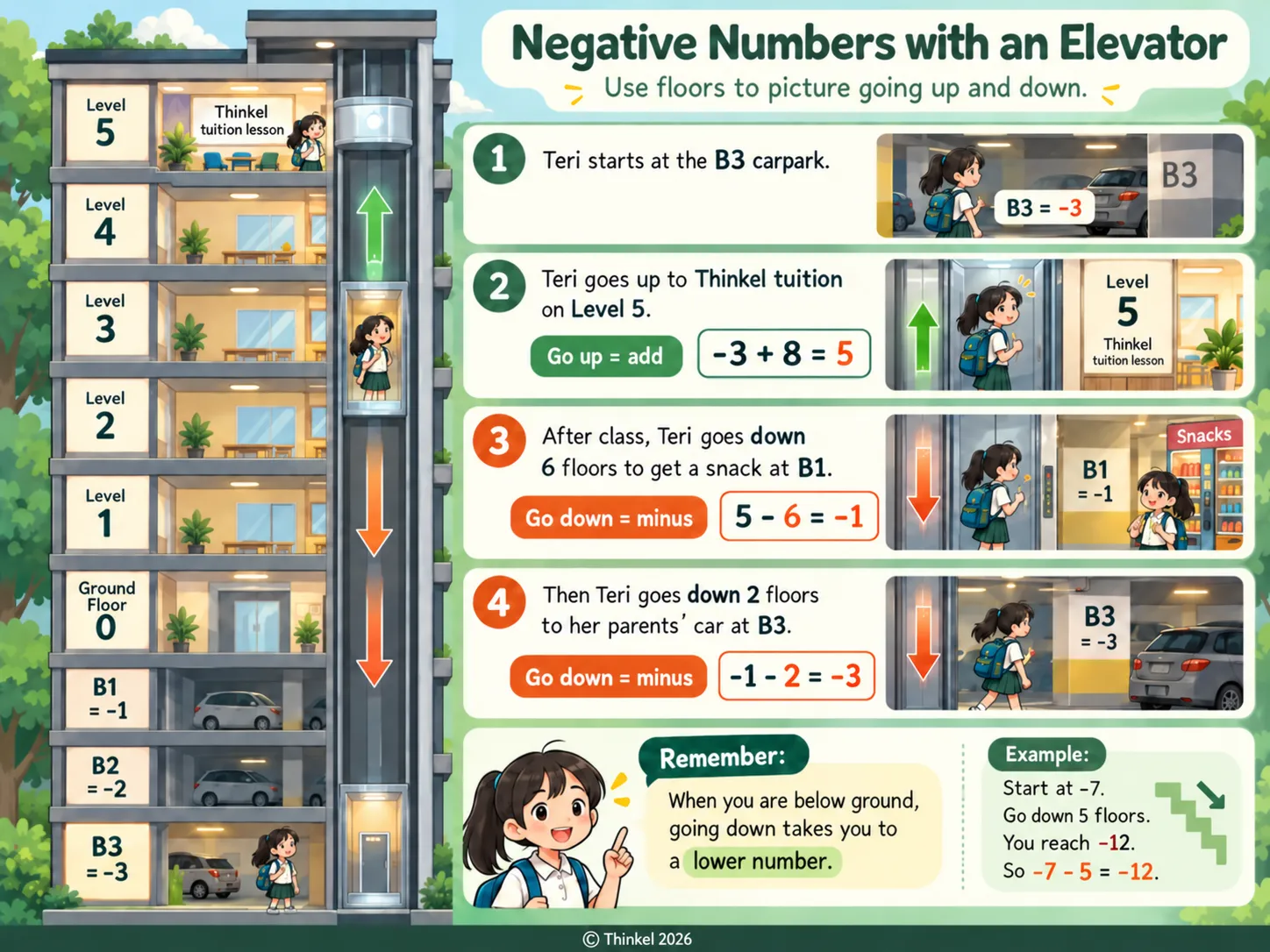
B1 means −1, B2 means −2, and B3 means −3.
Money
−$20 can mean a loss, debt or amount owed.
Integers and the number line
Integers are whole numbers, zero and negative whole numbers. They do not include fractions or decimals.
Greater or smaller?
Numbers become greater as we move to the right. Numbers become smaller as we move to the left.
−2 is greater than −5 because −2 is to the right of −5.
−6 is smaller than −1 because −6 is to the left of −1.
Common trap
Do not compare negative numbers by only looking at the digit.
8 is greater than 3.
But −8 is smaller than −3.
That is because −8 is further left on the number line.
Elevator model: go up and go down
The elevator model helps students picture negative numbers clearly. Ground floor is 0. Floors above ground are positive. Basement floors are negative.
Teaching rule
Go up = add
Go down = minus
Why −7 − 5 = −12
Start at −7. Minus 5 means go down 5 floors. You do not move towards 0. You reach −12.
−7 − 5 = −12
Adding integers
Adding a positive number moves right or up. Adding a negative number moves left or down.
Same direction
4 + 3 = 7
−4 + (−3) = −7
If both numbers move in the same direction, continue in that direction.
Different direction
5 + (−2) = 3
−5 + 2 = −3
When the signs are different, think about which side has the stronger movement.
Minusing integers
For this page, think of minus as movement down or left. This helps with examples such as −7 − 5.
Positive starting point
5 − 2 = 3
5 − 6 = −1
Start at 5. If you go down 6 floors, you pass 0 and reach −1.
Negative starting point
−1 − 2 = −3
−7 − 5 = −12
When you are already below zero, going down takes you to a lower number.
Negative numbers, integers and number line
Try these questions first. They focus on recognising negative numbers, comparing integers and using number-line thinking.
Write the integer represented by B4.
Think of basement floors below ground.Which is greater: −2 or −6?
Use their positions on the number line.Arrange in ascending order: 3, −1, −5, 0, 2.
Arrange in descending order: −4, 1, −2, 5, 0.
A temperature changes from 2°C to −3°C. Did it go up or down?
A carpark level is labelled B2. What integer can represent this level?
Which number is smaller: −8 or −3?
Fill in the blank: −6, −5, −4, ___, −2.
Adding and minusing negative integers
These questions focus on integer operations. Picture movement up, down, left or right.
Evaluate: 6 + (−4)
Evaluate: −3 + 8
Evaluate: −5 + (−7)
Evaluate: 4 − 9
Evaluate: −1 − 2
Evaluate: −7 − 5
Teri starts at B2. She goes up 5 floors. Which level does she reach?
Teri starts at Level 4. She goes down 7 floors. Which level does she reach?
A lift starts at −3 and goes up 6 floors. Write the calculation and answer.
A lift starts at −4 and goes down 3 floors. Write the calculation and answer.
Mixed questions
Use these questions to check whether students can switch between comparison, number lines and operations.
Arrange in ascending order: −7, −2, 4, 0, −5.
Evaluate: −9 + 4
Evaluate: −2 − 6
Evaluate: 3 − 8 + 2
A diver is at −6 m. He moves up 4 m. What is his new position?
A lift is at Level 2. It goes down 5 floors, then up 3 floors. Where does it stop?
Explain why −10 is smaller than −4.
Explain why −6 − 4 = −10 using the elevator model.
Answers and explanations
Use these answers after students have attempted the questions.
Practice Set 2A answers
Practice Set 2B answers
Mixed practice answers
Teaching notes and common misconceptions
Common misconceptions
Suggested classroom flow
Next step
After students are confident with negative numbers and integer operations, continue with multiplication, division, fractions, decimals and real numbers.