
Integers, Rational Numbers and Real Numbers
Learn how the number system expands from whole numbers to negative numbers, integers, fractions, decimals, rational numbers, irrational numbers and real numbers.
This chapter guide is written for Secondary 1 students and teachers. It gives the main ideas, worked examples, common mistakes and links to practice pages for the full Chapter 2 cluster.
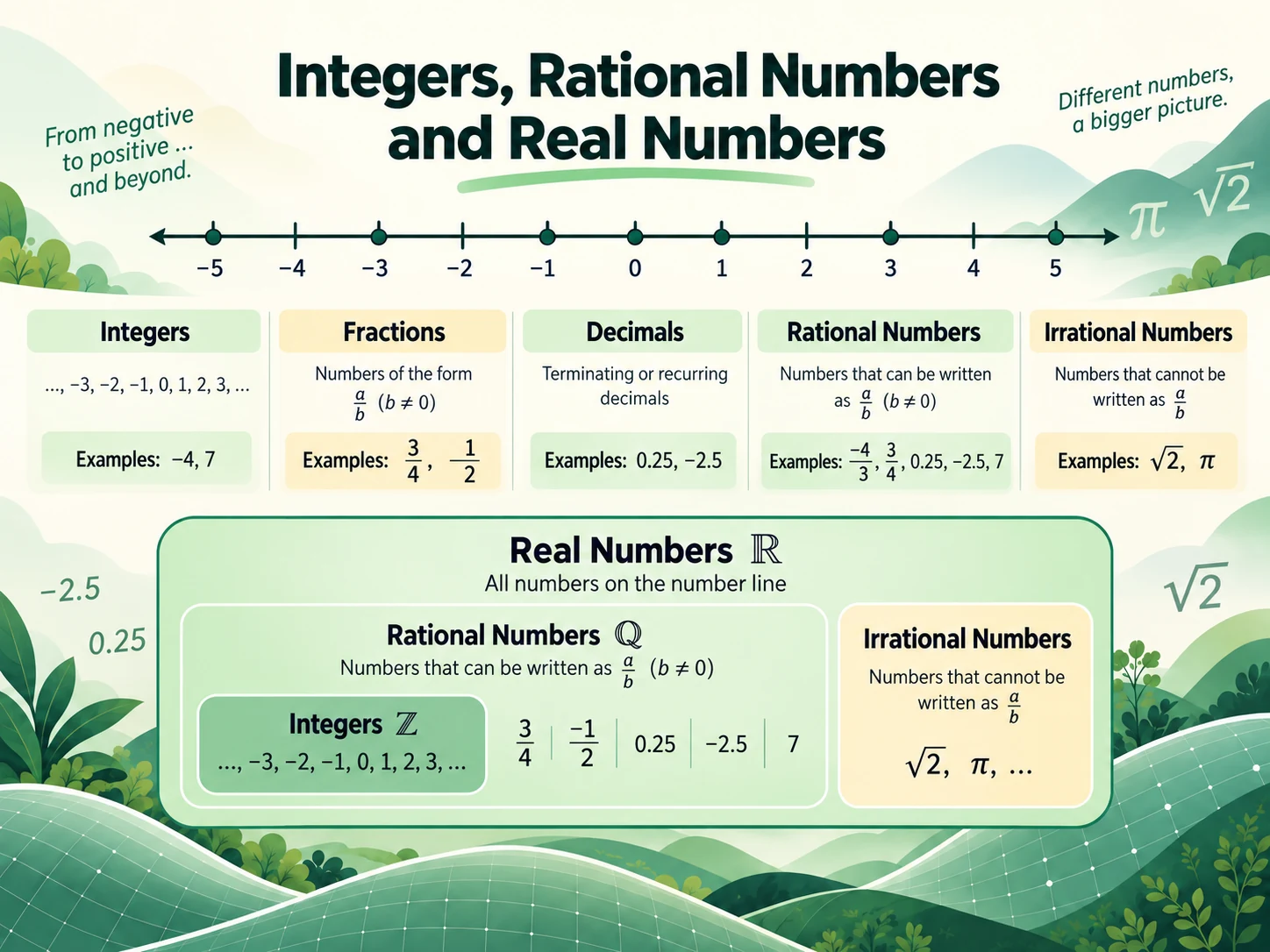
Chapter overview
This chapter helps students move beyond positive whole numbers. Students learn how negative numbers work, how integers behave under the four operations, and how fractions, decimals and irrational numbers fit into the real number system.
The big idea is that different types of numbers can still be compared, placed on a number line and used in real-world situations.
Learning goals and prerequisites
By the end of this chapter, students should be able to compare and operate with negative numbers, understand rational and irrational numbers, and explain how different number types fit inside the real number system.
Understand
Explain negative numbers, integers, rational numbers, irrational numbers and real numbers using examples and number lines.
Calculate
Add, minus, multiply and divide negative integers, fractions, mixed numbers and decimals using correct rules.
Connect
Recognise how number types are related, and decide whether answers are reasonable in real-world contexts.
Prerequisite knowledge
Students should already be comfortable with whole numbers, basic operations, fractions, decimals and simple square roots or cube roots.
Key vocabulary
Negative numbers
Negative numbers are numbers less than zero. They are useful when a quantity goes below a reference point, such as temperatures below 0°C, heights below sea level, basement floors, or money owed.
Positive and negative direction
The sign tells us which side of zero the number is on. Positive numbers are greater than zero. Negative numbers are less than zero.
+6 means 6 units above or to the right of zero.
−6 means 6 units below or to the left of zero.
The number 0 is neither positive nor negative.
Distance from zero
Some numbers are the same number of steps away from zero, but on different sides.
−8 is 8 steps below zero.
+8 is 8 steps above zero.
They are on opposite sides of 0.
Using an elevator to understand negative numbers
Many Sec 1 students understand negative numbers better when they can picture going up and going down. An elevator is useful because it shows clearly that going up means add, and going down means minus.
In this model, ground floor is 0. Floors above ground are positive numbers. Basement floors are negative numbers. So B1 means −1, B2 means −2, and B3 means −3.
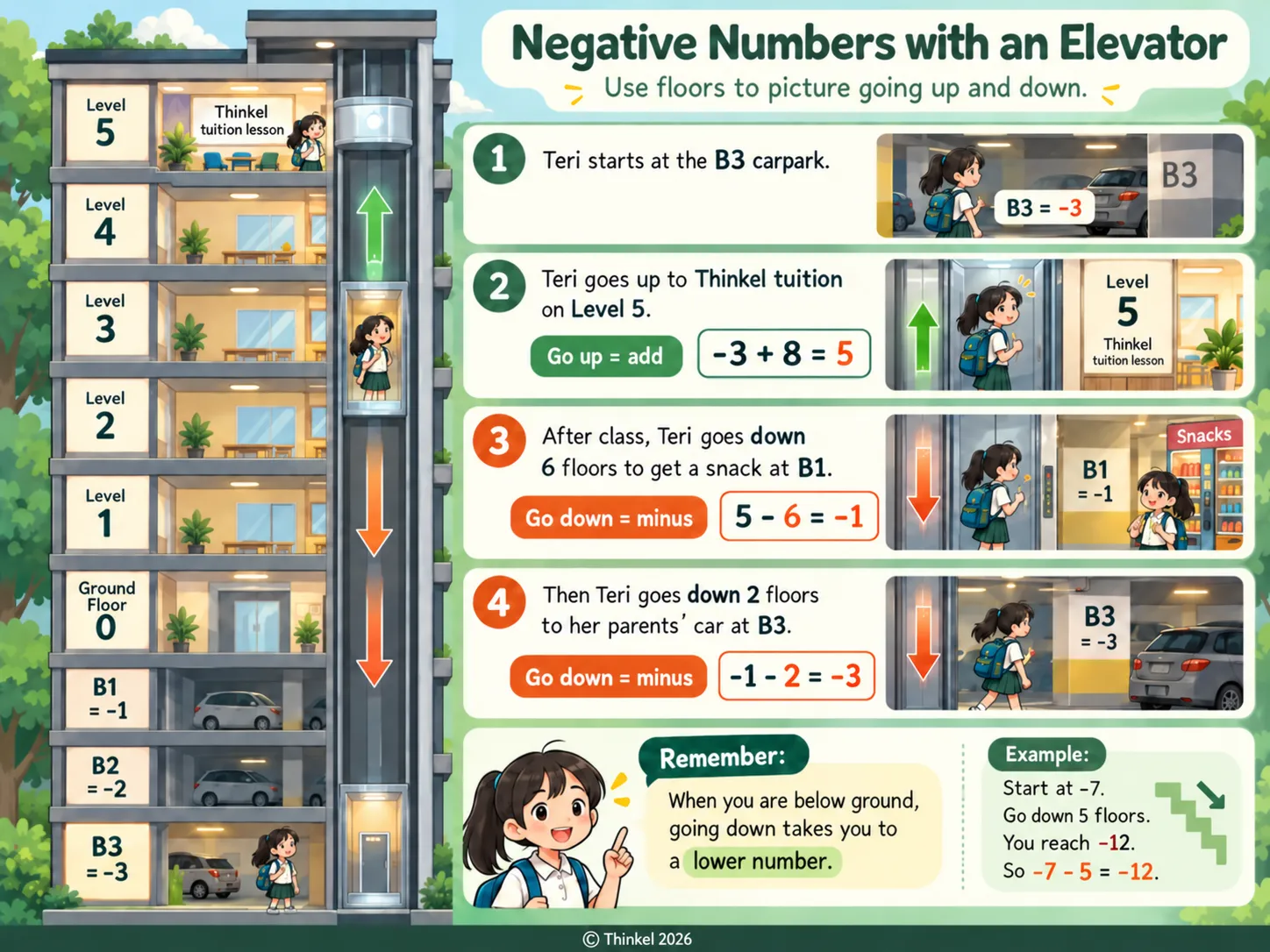
Teri’s elevator story
Teri starts at the B3 carpark. In Maths, B3 corresponds to −3. She takes the elevator up to her tuition lesson at Thinkel on Level 5.
Go up = add
Go down = minus
Why −7 − 5 = −12
Students often ask why −7 − 5 gives −12. The elevator model helps.
Start at −7.
Minus 5 means go down 5 floors.
You do not move towards 0.
You reach −12.
So, −7 − 5 = −12.
Integers and the number line
Integers are whole numbers, zero and negative whole numbers. They do not include fractions or decimals.
Ordering integers
On a horizontal number line, numbers become greater as we move to the right and smaller as we move to the left.
−1 is greater than −3 because −1 is closer to zero.
−5 is less than −2 because −5 is further left.
3 is greater than −4 because every positive number is greater than every negative number.
Common comparison mistake
Students sometimes think that −8 is greater than −3 because 8 is greater than 3. That is not correct.
Compare their positions on the number line.
−8 is further left than −3.
So, −8 < −3.
Add and minus negative integers
Adding and minusing negative integers becomes clearer when students think about movement on a number line or elevator.
Adding integers
Adding a positive number moves right or up. Adding a negative number moves left or down.
3 + 4 = 7
3 + (−4) = −1
−3 + (−4) = −7
Minusing integers
Minus means taking steps down or left, depending on the model used.
5 − 2 = 3
5 − 6 = −1
−1 − 2 = −3
−7 − 5 = −12
Practice link
The first practice page focuses on negative numbers, integers, number lines, ordering, going up/down models, addition and minus with negative integers.
Multiplication and division of negative integers
Multiplication and division involving negative integers follow clear sign rules. Students should understand the rules, then practise until the sign of the answer becomes automatic.
Worked examples
6 × (−3) = −18
(−6) × (−3) = 18
(−24) ÷ 6 = −4
(−24) ÷ (−6) = 4
Teaching shortcut
Count the number of negative signs in multiplication or division.
Odd number of negative signs → negative answer.
Even number of negative signs → positive answer.
Example: (−2) × (−3) × (−4) has three negative signs, so the answer is negative.
Combined operations with negative numbers
Combined operations require students to manage both operation order and signs. This is where many careless mistakes happen.
Order of operations
Worked example
Evaluate 6 − 2 × (−4).
Do multiplication first.
2 × (−4) = −8
6 − 2 × (−4) = 6 − (−8)
6 − (−8) = 14
Answer: 14
Practice link
The second practice page covers multiplication, division, combined operations, fractions, decimals and real number classification.
Fractions, mixed numbers and decimals
Once students can work with negative integers, the same ideas extend to negative fractions, mixed numbers and decimals. The arithmetic becomes more detailed, but the sign rules remain consistent.
Fractions
Add or minus fractions using a common denominator. Multiply and divide fractions using the usual fraction rules, while also checking the sign.
Mixed numbers
Convert mixed numbers to improper fractions when multiplication or division is involved. This keeps working cleaner.
Decimals
Line up decimal points when adding or minusing. For multiplication and division, handle the sign and decimal placement carefully.
Example with signs
−0.8 + 1.5 = 0.7
−0.8 − 1.5 = −2.3
(−0.4) × 3 = −1.2
(−1.2) ÷ (−0.3) = 4
Teacher note
Students often make two mistakes at once: one with the sign and one with the fraction or decimal calculation. Ask them to decide the sign first, then complete the numerical calculation.
Rational, irrational and real numbers
The final part of the chapter connects different number types. Whole numbers, integers, fractions, decimals and irrational numbers can all be understood as part of the real number system.
Real numbers
All numbers that can be placed on the number line.
Rational numbers
Rational numbers include integers, fractions, terminating decimals and recurring decimals.
7 is rational because 7 = 7/1.
0.25 is rational because 0.25 = 1/4.
−2.5 is rational because −2.5 = −5/2.
Irrational numbers
Irrational numbers cannot be written exactly as a fraction. Their decimal forms do not terminate or repeat.
√2 is irrational.
π is irrational.
These numbers still belong to the real numbers because they can be placed on the number line.
Practice pages for this chapter
Use the main page for teaching. Then move students through the practice pages in order. Each practice page can be used for classwork, self-study, revision or teacher-led review.
Common mistakes and teacher notes
This chapter has many calculation rules, so students need both conceptual understanding and careful practice.
Common mistakes
Teaching notes
Frequently asked questions
These questions clarify the common points students meet in this chapter.
What is the difference between a negative number and an integer?
Why is −2 greater than −5?
Why does −7 − 5 become −12?
Are all fractions rational numbers?
Are all decimals rational numbers?
Why are irrational numbers still real numbers?
Ready to practise Chapter 2?
Start with negative numbers and integer operations first. Then move to combined operations, fractions, decimals and the full chapter review.