
Linear Functions and Graphs
Learn how coordinates, function machines, tables of values and straight-line graphs work together. This page focuses on the key ideas students need before attempting the full printable practice PDF.
The graph examples use school-style green graph paper: square grids, hard green axes, thin graph lines and small crosses for plotted points.
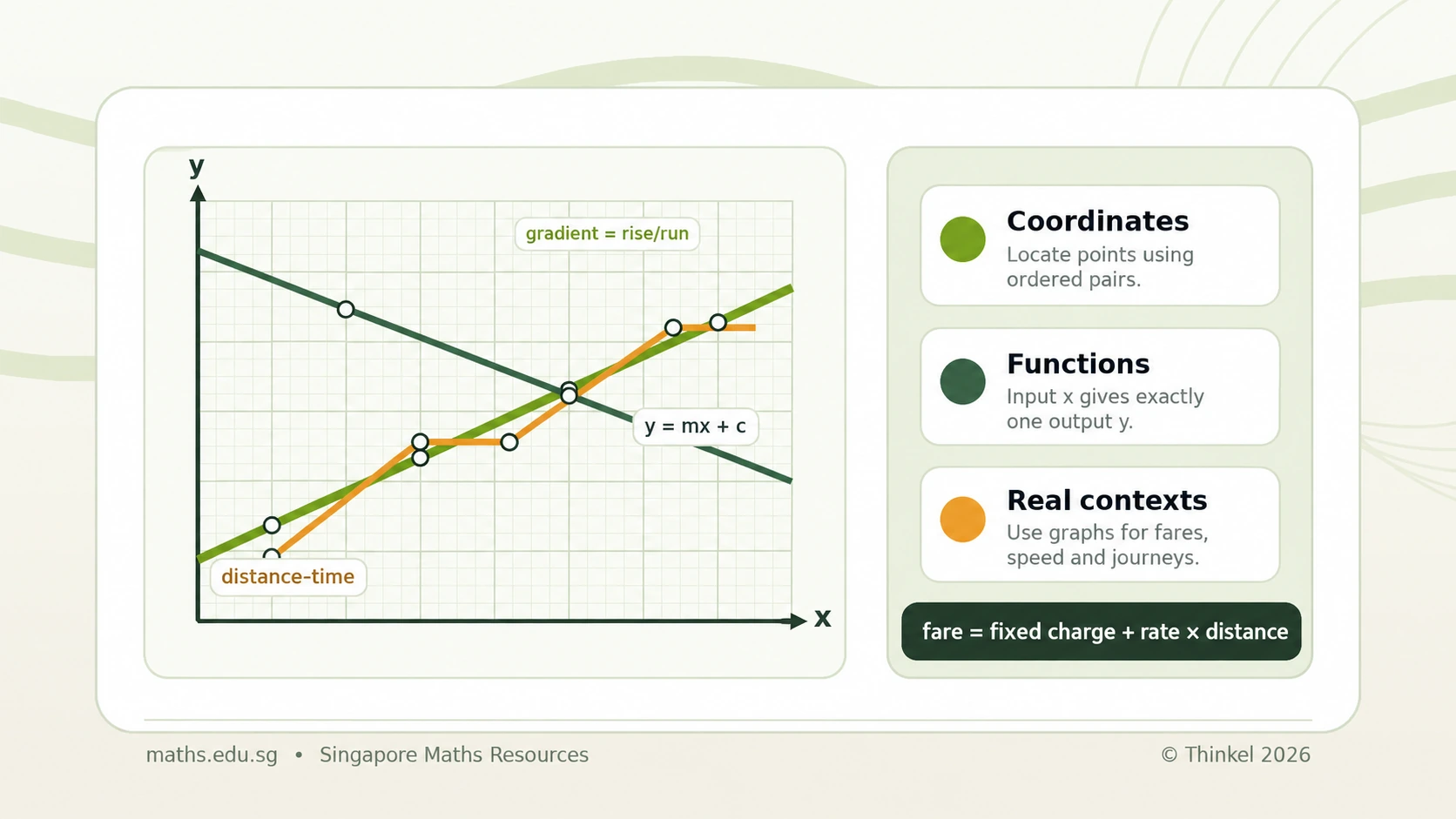
What students should be able to do
Read coordinates as \((x,y)\)
A point on a Cartesian plane is written as an ordered pair \((x,y)\). The \(x\)-coordinate tells us the horizontal position. The \(y\)-coordinate tells us the vertical position.
A function gives one output for each input
A function is a relationship where each input \(x\) gives exactly one output \(y\). A function can be shown using a rule, equation, table of values or graph.
Function machine
Function: \(y=x+3\)
Rule: add 3 to the input \(x\) to get the output \(y\).
\[ x \longrightarrow \boxed{+3} \longrightarrow y \]
Use the rule to complete the table
For \(y=x+3\), substitute each \(x\)-value into the rule.
| x | 0 | 1 | 2 | 3 |
|---|---|---|---|---|
| y | 3 | 4 | 5 | 6 |
Why this matters
Tables help students move from algebra to graphing. Once the \((x,y)\) pairs are known, they can plot the points and draw the straight-line graph.
Draw a straight-line graph from a table
A linear function such as \(y=x+1\) produces points that lie on a straight line. Plot the points using small crosses, then draw a thin straight line through them.
Gradient measures steepness
The gradient of a straight line compares vertical change with horizontal change:
\[ \text{gradient}=\frac{\text{vertical change}}{\text{horizontal change}} \]
Positive, negative, zero and undefined gradients
Positive
The line slopes upwards from left to right.
Negative
The line slopes downwards from left to right.
Zero
A horizontal line has gradient \(0\).
Undefined
A vertical line has undefined gradient.
Common trap: A vertical line is not gradient \(0\). Gradient \(0\) belongs to a horizontal line.
Use graphs to read real situations
Linear graphs can model fares, petrol use, data charges and distance-time journeys. Students should practise reading across and down from the graph before calculating.
How to read the graph
Start from the \(x\)-axis value, move vertically to the line, then move horizontally to the \(y\)-axis.
How to calculate cost
If 1 litre costs $1.40, first estimate the litres needed from the graph, then multiply by \(1.40\).
Watch for these mistakes
Swapping coordinates
\((2,5)\) is not the same as \((5,2)\). Read \(x\) first, then \(y\).
Using circles for plotted points
Use small crosses when plotting points on graph paper, especially for exam-style work.
Drawing thick graph lines
Lines should be thin enough so the plotted crosses and intersections remain clear.
Confusing intercept and gradient
In \(y=mx+c\), \(m\) is the gradient and \(c\) is the \(y\)-intercept.
Check readiness before doing the full worksheet
Try these 5 questions first. If the score is low, review the graph examples above before starting the PDF.
1. In the point \((4,2)\), what is the \(x\)-coordinate?
2. For \(y=x+3\), what is \(y\) when \(x=2\)?
3. In \(y=2x+1\), what is the \(y\)-intercept?
4. A horizontal line has gradient:
5. On a distance-time graph, a flat horizontal section usually means:
Try a few questions before the PDF
These questions are for projection and discussion. The full 1.5-hour practice workload is in the PDF.
1. Write the coordinates of the point that is 3 units to the right of the origin and 2 units up.
Reveal answer
\((3,2)\)
2. Complete the table for \(y=x+3\) when \(x=0,1,2,3\).
Reveal answer
The \(y\)-values are \(3,4,5,6\).
3. For \(y=2x\), what is \(y\) when \(x=5\)?
Reveal answer
\(y=2(5)=10\).
4. A line passes through \((0,3)\) and \((2,7)\). What is its gradient?
Reveal answer
\[ \text{gradient}=\frac{7-3}{2-0}=\frac{4}{2}=2 \]
5. In \(y=4x-1\), state the gradient and \(y\)-intercept.
Reveal answer
Gradient \(=4\), \(y\)-intercept \(=-1\).
6. Which is steeper: \(y=x+1\) or \(y=2x\)?
Reveal answer
\(y=2x\) is steeper because its gradient is 2, while \(y=x+1\) has gradient 1.
Use the PDF for the full practice workload
The webpage teaches and diagnoses. The PDF carries the main practice work: coordinates, function tables, straight-line graphs, gradients, real-world graph reading and answers.
Full chapter practice
Designed for about 1.5 hours of classwork or homework.
Graph-paper style
Square green grids, hard green axes, small crosses and thin graph lines.
Teacher-friendly
Includes answers, short explanations and teacher notes.
Suggested lesson flow
Ready to practise Linear Functions and Graphs?
Download the printable worksheet, complete the tables carefully, plot with small crosses, and draw thin graph lines so intersections remain clear.
 Stuck? Ask a free tutor