
Number Patterns
Learn how to recognise, describe and create number patterns. This chapter helps students find rules, write general terms and apply sequences to figure patterns and real-world situations.
Students will work with number sequences, Tn, arithmetic patterns, geometric patterns, Fibonacci-style patterns and diagram-based patterns.
What students should be able to do
Jump to a section
A number sequence follows a rule
A number sequence is a set of numbers arranged in order. The numbers are called terms. To continue a sequence, students need to identify the rule that generates the next term.
Use Tn for the nth term
The general term Tn gives a formula for the term in position n. Students must not confuse the position number n with the term value Tn.
| Position n | 1 | 2 | 3 | 4 | 5 | n |
|---|---|---|---|---|---|---|
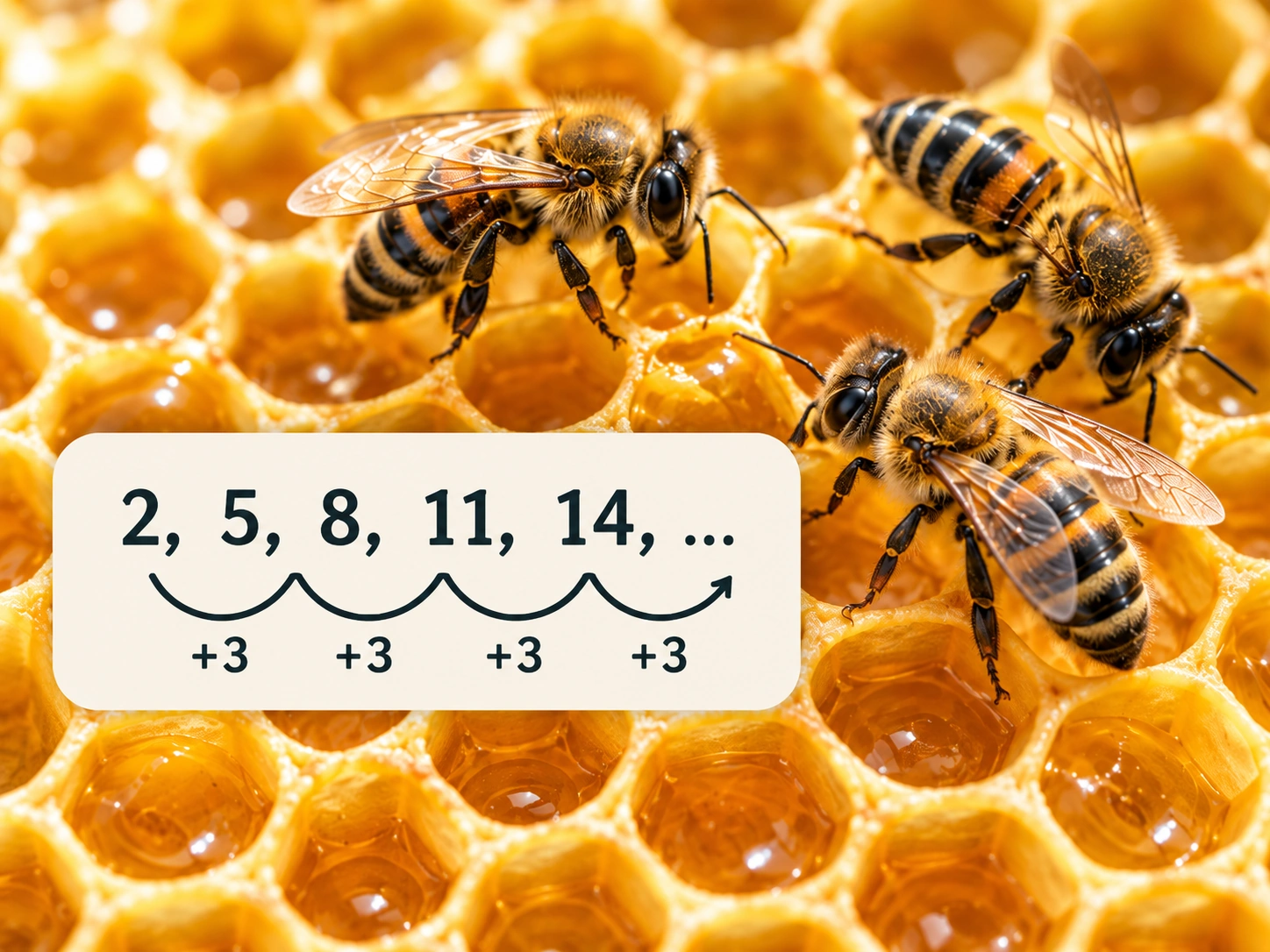
| Term Tn | 2 | 5 | 8 | 11 | 14 | 3n − 1 |
Swipe sideways to view the full table.
For the sequence 2, 5, 8, 11, 14, …, the general term is:
Tn = 3n − 1
Check the formula
A formula is useful only if it matches the sequence. Substitute n = 1, 2, 3 to check.
T1 = 3(1) − 1 = 2
T2 = 3(2) − 1 = 5
T3 = 3(3) − 1 = 8
So the formula matches the sequence.
Look beyond the first difference
Some sequences are simple arithmetic sequences. Others may involve multiplication, powers, squares, cubes or figure patterns. Students should observe carefully before writing the rule.
Arithmetic sequences
Terms change by a constant difference.
Example: 7, 11, 15, 19, …
Tn = 4n + 3
Geometric-type sequences
Terms are multiplied or divided by a fixed number.
Example: 2, 4, 8, 16, …
Tn = 2n
Square and cube patterns
Terms may involve n2, n3 or transformations of these.
Example: 1, 4, 9, 16, …
Tn = n2
Common trap: Do not decide the rule after checking only two terms. A pattern should be tested against several terms.
Figure patterns connect diagrams to formulae
Some patterns are shown using dots, triangles, tiles or lines. Students need to count carefully, organise the counts in a table, then look for a rule.
Patterns appear in nature and daily life
The chapter uses examples such as bee family trees, flower petals, Fibonacci patterns, Golden Ratio ideas and chemistry tables to show that number patterns are not just abstract calculations.
Each term can depend on earlier terms
Not all sequences use the same repeated difference. In a Fibonacci-type sequence, a term is found by adding earlier terms.
1, 1, 2, 3, 5, 8, 13, …
Each new term is found by adding the two previous terms.
Important: Students should identify the rule before applying a formula. Different patterns need different methods.
Watch for these mistakes
Confusing n and Tn
n is the position number. Tn is the term value at that position.
Guessing too early
Check several terms before deciding the rule.
Assuming every pattern is arithmetic
Some patterns involve multiplication, powers, figures or previous terms.
Miscounting figure patterns
Use a table to organise figure number and total count.
Check readiness before doing the full worksheet
Try these 5 questions first. After clicking Check answers, each question will show a short explanation or trap reminder.
1. What is the next term in 2, 5, 8, 11, 14, …?
2. In Tn, what does n represent?
3. If Tn = 4n + 1, what is T5?
4. Which sequence is geometric-type?
5. For a figure pattern, what should students usually do first?
Core examples to discuss in class
Example 1. Find the next two terms of 7, 11, 15, 19, …
Reveal working
The common difference is +4. The next two terms are 23 and 27.
Example 2. For Tn = 5n − 2, find T8.
Reveal working
T8 = 5(8) − 2 = 40 − 2 = 38
Example 3. A sequence starts 3, 7, 11, 15, … Find a formula for Tn.
Reveal working
The common difference is 4, so the formula has 4n.
Since T1 = 3, 4(1) − 1 = 3.
So Tn = 4n − 1.
Try a few questions before the PDF
These questions are for quick diagnosis. The full worksheet is in the PDF.
1. Write the next two terms of 4, 9, 14, 19, …
Reveal answer
24, 29
2. Find T6 if Tn = 3n + 2.
Reveal answer
T6 = 3(6) + 2 = 20
3. A sequence is 5, 8, 11, 14, … Find a formula for Tn.
Reveal answer
The formula is Tn = 3n + 2.
4. The first four triangular numbers are 1, 3, 6, 10. What is the fifth?
Reveal answer
The fifth triangular number is 15.
5. Why should students test a general term formula?
Reveal answer
To check that the formula produces the correct terms in the sequence.
Use the PDF for the full practice workload
The webpage teaches and diagnoses. The PDF carries the main practice work: sequences, general terms, figure patterns, Fibonacci-style contexts and real-world tables.
82 questions
Designed for sustained practice across the chapter.
Tables and patterns
Includes n, Tn, dot patterns, figure patterns and real-world tables.
Answers included
Includes answers, short explanations and teacher notes.
Suggested lesson flow
Ready to practise Number Patterns?
Download the printable worksheet, check the pattern rule carefully, and use Tn only after you understand how the sequence is formed.
 Stuck? Ask a free tutor