Basic Geometry
Learn to name and measure angles, use the properties of intersecting lines, and reason with parallel lines and a transversal.
This classroom resource pairs precise, clean diagrams with step-by-step explanations. Every angle is named with the vertex in the middle: ∠ABC means the angle at B.
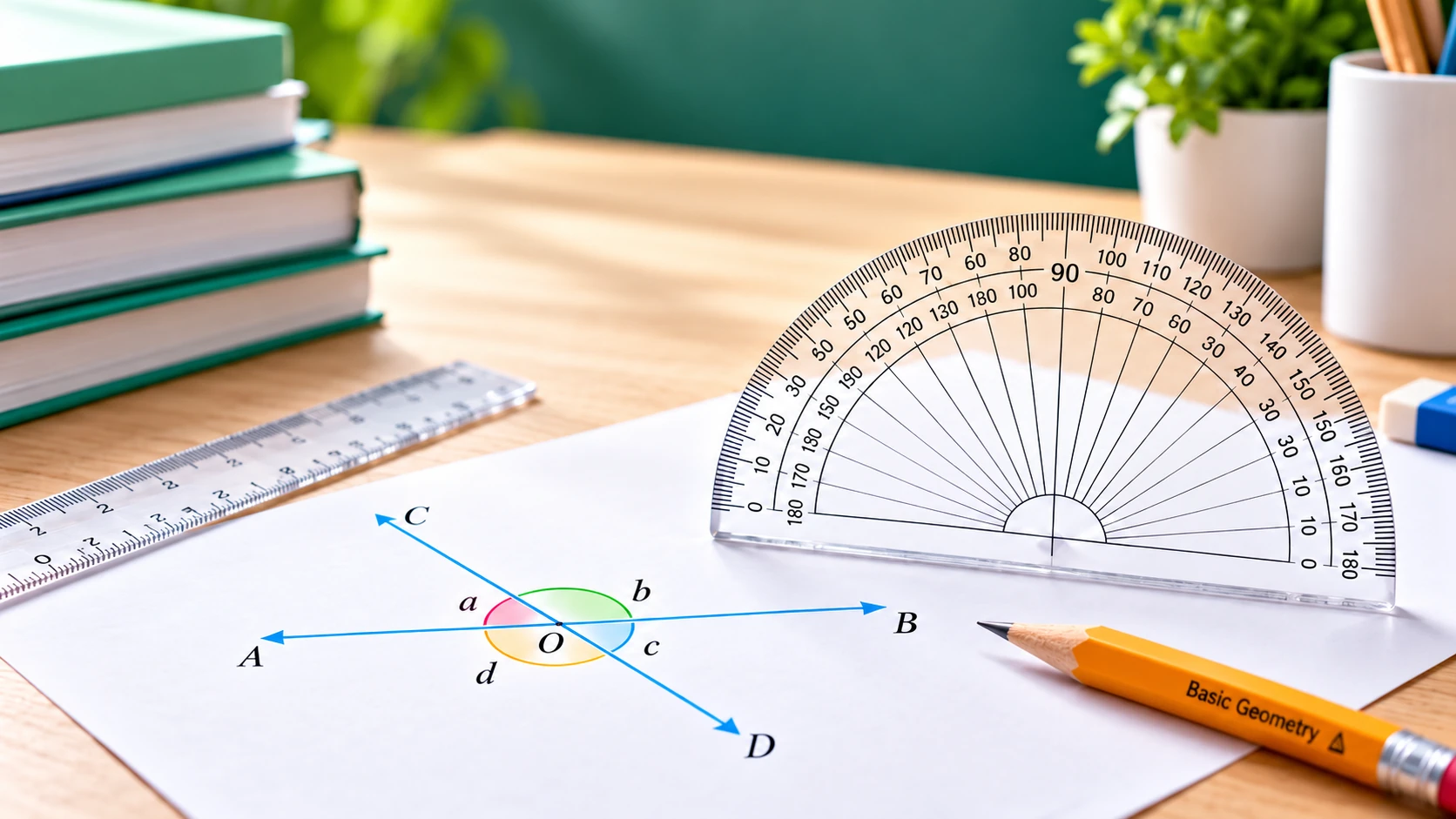
Learning goals
Read diagrams
Identify points, rays, lines, vertices, and angles using correct notation.
Explain angle rules
Use a straight line, a full turn, vertically opposite angles, and parallel-line properties.
Solve problems
Combine properties in two- or three-step questions and explain the reasoning.
1. Naming an angle
A line extends indefinitely in both directions. A ray has one endpoint and extends in one direction. An angle is formed by two rays meeting at a vertex.
Line AB
Extends indefinitely in both directions.
Ray CD
Starts at C and extends through D.
Line segment EF
Has two endpoints, E and F.
How to read ∠ABC
The middle letter B identifies the vertex. The arms are BA and BC.
∠BAC is a different angle: its vertex is A.
Angle types
| Type | Measure | Example |
|---|---|---|
| Acute | Between 0° and 90° | 45° |
| Right | 90° | 90° |
| Obtuse | Between 90° and 180° | 120° |
| Straight | 180° | 180° |
| Reflex | Between 180° and 360° | 250° |
| Full turn | 360° | 360° |
2. Measuring and drawing angles
Use a physical semicircular protractor with two scales. The scale you read depends on which ray is aligned with 0°.
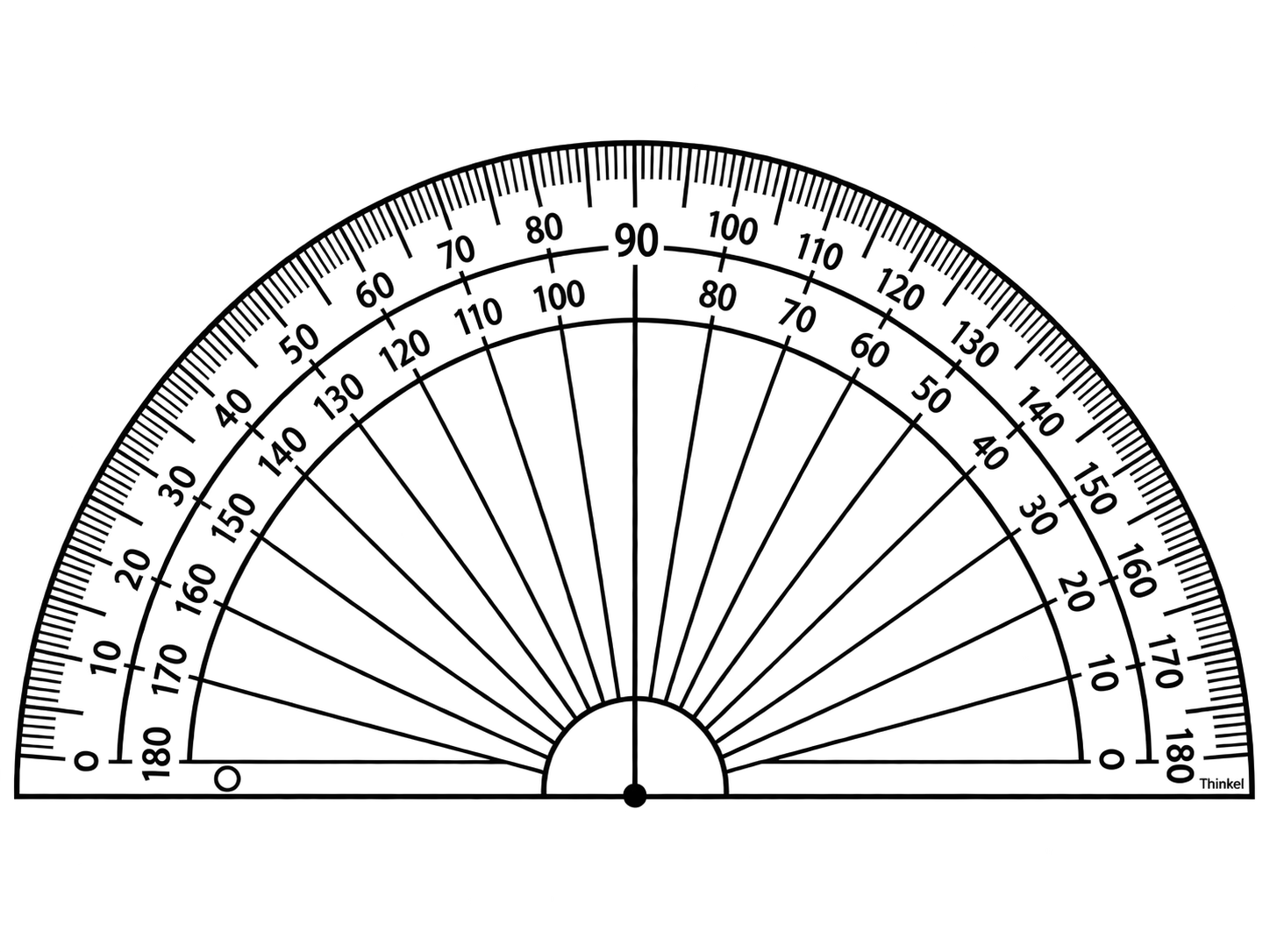
School-style protractor: align its centre with the angle vertex and select the scale that starts at 0° along the chosen arm.
Worked method: measuring 60°
- Put the centre hole on the vertex.
- Align the starting ray with the 0° mark on the appropriate scale.
- For a 60° angle, the other ray should meet the 60° mark on that same scale.
- Check that 60° is acute; if you read 120°, you probably used the opposite scale.
To draw 60°, mark 60° on that scale, then draw a ray from the vertex through the mark.
- Put the protractor centre precisely on the vertex.
- Align the 0° baseline with one arm of the angle.
- Check whether the angle is acute or obtuse before choosing the correct inner or outer scale.
- Read the value where the other arm crosses the scale. Record the answer in degrees.
Example: Complementary angles
Given ∠ABD = 34° and ∠ABC = 90°, find ∠DBC.
Reveal working
∠DBC = 90° − 34° = 56° (complementary angles).
Example: Supplementary angles
Given ∠PQR = 117° and ∠RQS is its supplement, find ∠RQS.
Reveal working
∠RQS = 180° − 117° = 63°.
3. Straight lines, angles at a point and vertically opposite angles
Three rules to teach
Angles on a straight line: adjacent angles sum to 180°.
Angles at a point: a complete turn sums to 360°.
Vertically opposite angles: opposite angles formed by intersecting straight lines are equal.
Worked example: Vertically opposite
In the figure, lines AOD and BOC intersect at O. Given ∠AOB = 112°, find ∠COD and ∠BOD.
Reveal step-by-step solution
∠COD = 112° (vertically opposite angles).
∠BOD = 180° − 112° = 68° (angles on a straight line).
Worked example: Angles at a point
Given ∠AOB = 130° and ∠BOC = 95°, find the remaining angle ∠COA (the angle from OC to OA that completes the full turn).
Show working
∠COA = 360° − 130° − 95° = 135° (angles at a point).
Worked example: Algebra
A, O and C lie on a straight line, and ray OB lies between OA and OC. Given ∠AOB = (3x + 10)° and ∠BOC = (2x + 20)°, find x.
Reveal step-by-step solution
(3x + 10) + (2x + 20) = 180.
5x + 30 = 180.
5x = 150, so x = 30.
4. Corresponding, alternate and interior angles
A transversal is a line that intersects two or more other lines. When it crosses parallel lines, specific angle relationships follow.
Three key relationships
Corresponding: angles in matching positions are equal.
Alternate: angles on opposite sides of the transversal, between the parallel lines, are equal.
Interior on the same side: their sum is 180°.
Corresponding
Given ∠BTU = 52°, find ∠DUF.
Show working
∠DUF = 52° (corresponding angles).
Alternate angles
Given ∠ATU = 128°, find ∠TUD.
Show working
∠TUD = 128° (alternate angles).
Interior angles
Given ∠BTU = 52°, find ∠TUD.
Show working
∠TUD = 180° − 52° = 128° (interior angles on the same side).
Interactive classroom demonstration: choose a property and change the transversal angle.
Explore angles in parallel lines
Choose an angle relationship, then drag the blue handle or use the slider. The two green lines remain parallel while the transversal changes direction.
The blue handle can be moved up or down. All point names update with the diagram.
Select a property
Worked example: Algebra with corresponding angles
Using the labelled parallel-line figure above, AB ∥ CD. Given ∠BTU = (2𝑥 + 14)° and ∠DUF = (3𝑥 − 9)°, find 𝑥 and ∠BTU.
Show working
2𝑥 + 14 = 3𝑥 − 9 (corresponding angles).
𝑥 = 23.
∠BTU = 2 × 23 + 14 = 60°.
5. Multi-step geometry reasoning
Students should identify the unknown angle, choose the relevant properties and write the reason for each step. A useful advanced technique is to draw an auxiliary line parallel to the given pair.
Worked example: Zigzag between parallel lines
In the figure, AB ∥ CD. Given ∠BPQ = 36° and ∠DRQ = 42°, find ∠PQR.
Step-by-step reasoning
- Draw a line through Q parallel to AB and CD.
- By alternate angles, the part of ∠PQR above the auxiliary line is 36°.
- By alternate angles, the part below it is 42°.
- ∠PQR = 36° + 42° = 78°.
Worked example: Triangle and intersecting lines
In △ABC, given ∠BAC = 47° and ∠ABC = 63°, find ∠ACB and ∠CBD, where AB is extended beyond B to D.
Show working
∠ACB = 180° − 47° − 63° = 70° (angles in a triangle).
∠CBD = 180° − 63° = 117° (angles on a straight line).
Triangle angle sum is used here as a supporting skill; the core Chapter 10 emphasis remains angle properties.
Can students identify the correct angle rule?
Select one answer per question, then check. Each question gives an explanation.
1. In ∠PQR, which letter represents the vertex?
Q is the middle letter, so Q is the vertex.
2. A, O and C lie on a straight line. ∠AOB = 73°. Find ∠BOC.
Angles on a straight line add to 180°, so ∠BOC = 180° − 73° = 107°.
3. Lines AOD and BOC intersect at O. ∠AOB = 124°. Find ∠COD.
∠AOB and ∠COD are vertically opposite angles, so both are 124°.
4. Two parallel lines are cut by a transversal. One corresponding angle measures 59°. Find the other.
Corresponding angles between parallel lines are equal, so the angle is 59°.
5. Two interior angles on the same side of a transversal between parallel lines are 116° and ∠XYZ. Find ∠XYZ.
Same-side interior angles add to 180°, so ∠XYZ = 64°.
Suggested classroom flow
Explain: Angle notation → types and measurement → intersecting lines → parallel lines → multi-step reasoning.
Demonstrate: Use the reveal-working cards, asking students to name the angle property before showing the calculation.
Practise: Use PDF 1 for textbook-style explanations, worked examples and guided practice. Use PDF 2 for additional geometry challenges.
PDF 1 — Basic Geometry Practice Workbook
13-page textbook-style companion with teaching notes, worked examples, questions and answers.
Open PDF 1 — Practice WorkbookPDF 2 — Supplementary Practice
12 additional geometry questions, four questions per page.
Open PDF 2 — Supplementary Questions