
Approximation and Estimation
Learn how to round numbers, use significant figures, estimate quantities and decide whether an answer is reasonable in real-life situations.
This page is designed for teaching and diagnosis. Use the downloadable PDF for the full 116-question classwork and homework practice.
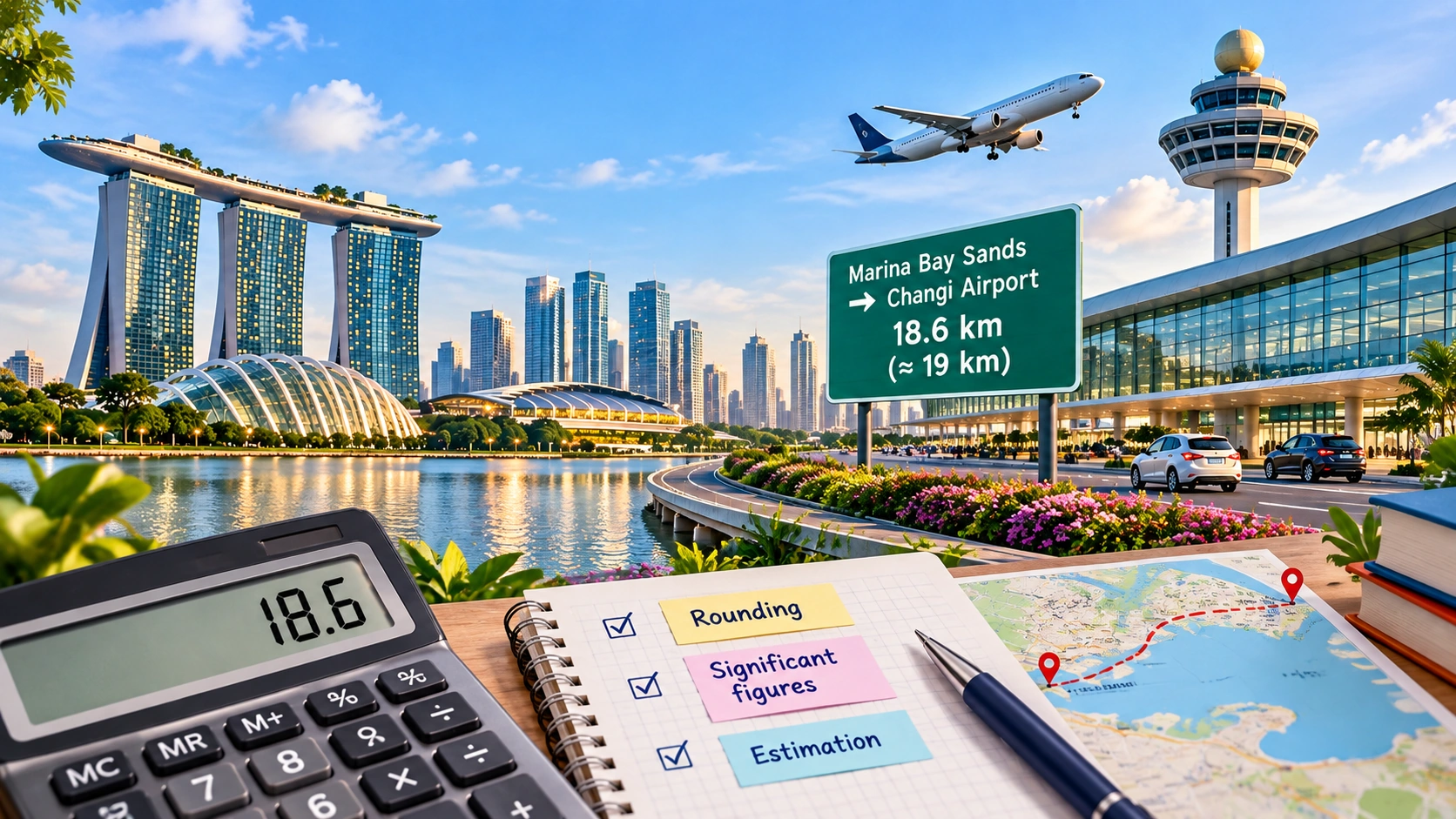
What this chapter trains
Approximation and estimation are not just about rounding. Students must know the required accuracy, avoid common boundary mistakes and judge whether an answer is reasonable.
Actual, approximate and estimated values
The chapter starts with a real-life distinction: exact values are not always known or needed. A measured distance may be rounded to an approximate value, while a person may give a rough estimate before checking.
Actual value
The exact value, when it is known or measured accurately.
Example: a measured driving distance of 18.6 km.
Approximate value
A value obtained by rounding a given value.
Example: 18.6 km ≈ 19 km.
Estimated value
A sensible guess or mental calculation made without exact data.
Example: about 10 km.
Rounding numbers
Rounding questions test whether students can identify the required place value and look at the correct next digit.
Rounding decision
If the next digit is 5 or more, round up.
If the next digit is less than 5, keep the digit unchanged.
Example for projection
Round 698 352 to the nearest 10.
Reveal teaching answer
The tens digit is 5. The next digit is 2.
Since 2 is less than 5, keep the tens digit unchanged.
698 352 ≈ 698 350
Significant figures
Significant figures show the degree of accuracy of a number. This chapter pays special attention to zeros, because zeros can be significant or not significant depending on where they appear.
Common traps that cost marks
These are the mistakes that should be checked before students start the full PDF exercise.
504 has 3 significant figures. 504.0 has 4 significant figures. Dropping the zero can lose the required accuracy.
In 0.028030, the final 0 is significant because it is written after the decimal to show the stated accuracy.
If 5 710 000 is rounded to the nearest 10 000, the largest possible integer is 5 714 999, not 5 715 000.
Rounding intermediate working can create follow-through errors. Keep enough figures until the final answer.
2 decimal places and 2 significant figures are different instructions. Read the required accuracy carefully.
Do not compare only total price. Compare a common quantity such as 100 g, 1 kg, 100 ml or 1 item.
Estimation in real-life contexts
Estimation helps students decide whether an answer makes sense before or after using a calculator. The chapter includes estimation in computations, shopping, currency conversion, value-for-money and larger quantities.
Computation check
Estimate before trusting a calculator answer.
31.5 + 9.87 − 2.1
≈ 32 + 10 − 2 = 40
Currency estimate
Round the exchange rate to make a quick mental check.
225 baht at about S$0.04 per baht
≈ S$9
Larger quantity estimate
Use a smaller sample to estimate a larger amount.
Estimate coins, grains, area or shaded regions by sampling.
Quick Self-Check before PDF practice
This short quiz checks whether students are ready for the full 116-question PDF. It focuses on traps, not practice volume.
1. Which answer shows 503.98 rounded to 4 significant figures?
2. 5 710 000 is rounded to the nearest 10 000. Which is the largest possible integer value?
3. How many significant figures are there in 0.028030?
4. Correct 45.7395 to the nearest 0.01.
5. Estimate 31.5 + 9.87 − 2.1 by rounding mentally.
Diagnostic practice questions
These questions are for projection and discussion. Answers are hidden so students can attempt first. Use the PDF for the full classwork and homework set.
Round 698 352 to the nearest 10, 100 and 1000.
Skill tested: place-value rounding.Reveal diagnostic answer
3 marks698 350; 698 400; 698 000.
Trap: each part asks for a different place value.
Correct 45.7395 to 1 decimal place and to the nearest 0.01.
Skill tested: decimal-place accuracy.Reveal diagnostic answer
2 marks1 decimal place: 45.7. Nearest 0.01: 45.74.
Trap: nearest 0.01 means 2 decimal places.
State the number of significant figures in 39 018, 0.028030 and 700.40600.
Skill tested: significant digits and zeros.Reveal diagnostic answer
3 marks39 018 has 5 s.f.; 0.028030 has 5 s.f.; 700.40600 has 8 s.f.
Trap: leading zeros before 2 are not significant, but the zero between 8 and 3 and the final zero after 3 are significant.
Round 503.98 to 4 significant figures.
Skill tested: preserving required accuracy.Reveal diagnostic answer
2 marks503.98 ≈ 504.0.
Trap: 504.0 shows 4 significant figures. 504 shows only 3 significant figures.
Singapore’s population was stated as 5 710 000, rounded to the nearest 10 000. What are the smallest and largest possible integer values?
Skill tested: discrete bounds.Reveal diagnostic answer
2 marksSmallest possible value: 5 705 000.
2 marksLargest possible integer value: 5 714 999.
Trap: 5 715 000 would round up to 5 720 000, so it is not included.
A timing was reported as 50.4 s, but the actual timing was recorded to 0.01 s. Give three possible actual timings.
Skill tested: possible values after rounding.Reveal diagnostic answer
3 marksExamples: 50.35 s, 50.38 s, 50.44 s.
Boundary idea: values from 50.35 s up to 50.44 s round to 50.4 s to 1 decimal place.
Estimate 31.5 + 9.87 − 2.1 mentally. Then calculate the exact value.
Skill tested: estimation versus exact calculation.Reveal diagnostic answer
1 markEstimate: about 40.
1 markExact value: 39.27.
Diagnostic point: the estimate is close enough to show that the exact answer is reasonable.
A wallet costs 225 Thai baht. If 1 baht is about S$0.04, estimate the price in Singapore dollars.
Skill tested: currency estimation.Reveal diagnostic answer
2 marks225 × 0.04 ≈ S$9.
Trap: do not over-calculate if the question asks for an estimate.
Option A is 200 g for $6. Option B is 250 g for $7.45. Which option gives better value for money?
Skill tested: comparing using a common quantity.Reveal diagnostic answer
2 marksOption A: $6 ÷ 200 × 100 = $3 per 100 g.
2 marksOption B: $7.45 ÷ 250 × 100 = $2.98 per 100 g.
1 markOption B gives slightly better value for money.
Trap: do not compare only the total price or only the package size.
A bottle contains 102 g of powder. Estimate the total mass of 5 bottles.
Skill tested: quick quantity estimation.Reveal diagnostic answer
1 mark102 g ≈ 100 g.
1 mark5 bottles ≈ 500 g.
Trap: the answer is an estimate, so 510 g may be exact calculation but not necessary for the estimation task.
Use the PDF for classwork and homework
The webpage is designed for teaching, diagnosis and discussion. The PDF is the main practice asset for students.
116 questions
The PDF has a full expanded question bank for about 1.5 hours of practice.
Printable answers
Unlike the webpage, the PDF keeps answers and explanations visible for offline use.
Teacher-friendly
Use the page to teach and project. Use the PDF for student attempts and follow-up marking.
How to use this page in class
Suggested lesson flow
What to watch for
Students confuse decimal places with significant figures.
Students write 504 instead of 504.0.
Students miss the final zero in decimals such as 0.028030.
Students include the upper boundary when it should be excluded.
Students round too early in intermediate working.
Students compare value for money without using a common quantity.
Ready for Chapter 3 practice?
Download the PDF for the full worksheet, then use the self-check and diagnostic reveals when you need help with common traps.
 Stuck? Ask a free tutor