
Basic Algebra and Algebraic Manipulation
Learn how algebra uses letters, variables and expressions to represent numbers, patterns and relationships.
This page teaches the key ideas and checks for common algebra mistakes. Use the PDF for the full printable classwork and homework practice.
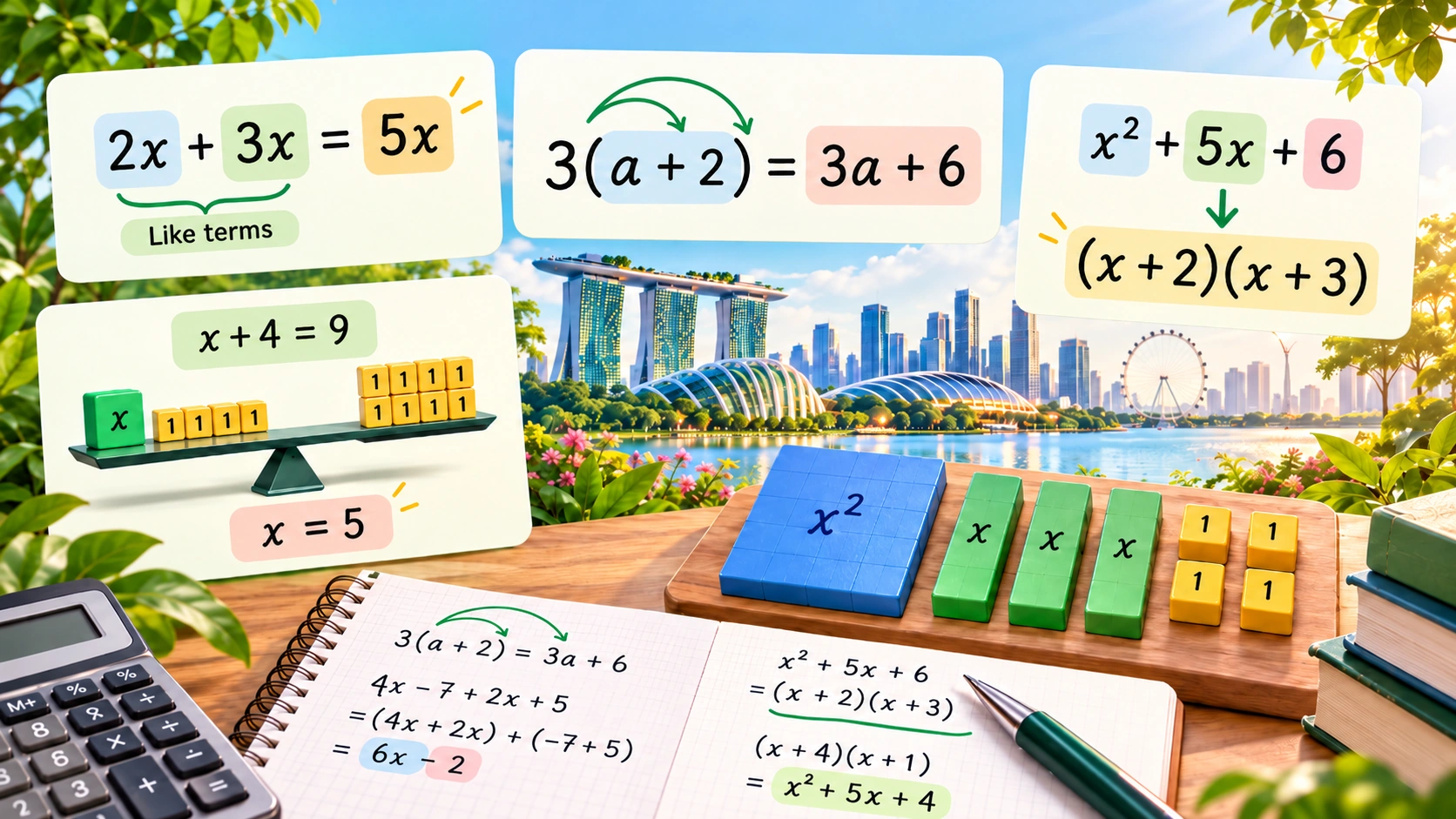
What this chapter trains
Basic algebra is not just about writing letters. Students must understand what letters represent, how terms combine, and when expressions are equivalent.
Algebraic notation and variables
Algebra uses letters to represent numbers. Sometimes the letter represents a specific unknown. Sometimes it represents a general number or a variable quantity.
Specific unknown
A letter can stand for one fixed number that we want to find.
x + 4 = 9
So x = 5.
Generalised number
A letter can represent any number when we describe a rule.
a + b = b + a
This shows addition can be done in either order.
Variable
A letter can represent a quantity that changes.
P = 4l
The perimeter changes when the side length changes.
Algebraic expressions
An algebraic expression is made up of variables, constants and operations. Expressions do not need an equals sign.
Parts of an expression
In 2x − 3xy + 4:
2x, −3xy and 4 are terms.
2 and −3 are coefficients.
4 is a constant term.
Substitution example
Evaluate 3x − 2y when x = 5 and y = −3.
Reveal teaching answer
3x − 2y = 3(5) − 2(−3)
= 15 + 6
= 21
Trap: −2(−3) becomes +6.
Like and unlike terms
Like terms have the same variable part. To add or minus like terms, add or minus their coefficients only.
Expansion and factorisation
Expansion uses the distributive law. Factorisation reverses the process by taking out a common factor.
Expansion
3(a + 2) = 3a + 6
−2(x + y) = −2x − 2y
4(2x − 3) = 8x − 12
Factorisation
6x + 12 = 6(x + 2)
3x − 3y = 3(x − y)
−2x − 10 = −2(x + 5)
Linear expressions with fractional coefficients
Fractional coefficients require careful simplification. The usual rules still apply: group like terms and use equivalent fractions.
Equivalent notation
n ÷ 2 = n2
12 × n = n2
They represent the same value.
Example for projection
Simplify 12x + 34x.
Reveal teaching answer
12x + 34x = 24x + 34x
= 54x
= 5x4
Trap: the variable part is the same, so combine the fractional coefficients.
Common algebra traps that cost marks
These are the mistakes students should check before starting the full PDF practice.
2x + 3y cannot become 5xy or 5x. The variables are different.
−2(x + 3) = −2x − 6, not −2x + 6.
3(a + 2) means 3a + 6. Every term inside the bracket must be multiplied.
6x + 9 factorises as 3(2x + 3), not 6(x + 9).
x + x² cannot be simplified into 2x² or 2x.
12x + 13x = 56x, not 25x.
Quick Self-Check before PDF practice
This short quiz checks whether students are ready for the full Chapter 4 PDF. It focuses on common algebra traps, not practice volume.
1. Simplify 2x + 3x.
2. Which expression cannot be simplified further?
3. Expand −3(x − 2).
4. Factorise 8x + 12 completely.
5. Simplify 12x + 13x. Type your answer as a fraction, e.g. 5x/6.
Diagnostic practice questions
These questions are for projection and discussion. Answers are hidden so students can attempt first. Use the PDF for the full classwork and homework set.
Write an algebraic expression for the sum of 2x and 3y.
Skill tested: writing expressions.Reveal diagnostic answer
1 mark2x + 3y.
Trap: do not write 5xy. The terms are not like terms.
Evaluate 3x − 2y when x = 5 and y = −3.
Skill tested: substitution with negative values.Reveal diagnostic answer
1 mark3(5) − 2(−3).
1 mark15 + 6 = 21.
Trap: minus a negative becomes plus.
Simplify 4x + 7 − 2x + 5.
Skill tested: grouping like terms and constants.Reveal diagnostic answer
2 marks4x − 2x + 7 + 5 = 2x + 12.
Trap: combine x-terms with x-terms and constants with constants.
Simplify 3x + 2y − x + 5y.
Skill tested: two-variable like terms.Reveal diagnostic answer
2 marks3x − x + 2y + 5y = 2x + 7y.
Trap: x-terms and y-terms are not like terms.
Expand 5(a − 3).
Skill tested: distributive law.Reveal diagnostic answer
2 marks5(a − 3) = 5a − 15.
Trap: multiply every term inside the bracket by 5.
Expand −2(x + 4).
Skill tested: expansion with negative multiplier.Reveal diagnostic answer
2 marks−2(x + 4) = −2x − 8.
Trap: the negative multiplier affects both terms.
Factorise 12x − 18 completely.
Skill tested: highest common factor.Reveal diagnostic answer
2 marks12x − 18 = 6(2x − 3).
Trap: use the highest common factor, not just any common factor.
Factorise −6x − 15 completely by taking out a negative common factor.
Skill tested: negative common factor.Reveal diagnostic answer
2 marks−6x − 15 = −3(2x + 5).
Trap: the signs inside the bracket change when −3 is taken out.
Simplify 12x + 13x.
Skill tested: fractional coefficients.Reveal diagnostic answer
2 marks12x + 13x = 36x + 26x = 56x.
Trap: use a common denominator before combining coefficients.
Expand and simplify 2(x + 3) + 4x.
Skill tested: expansion followed by simplification.Reveal diagnostic answer
1 mark2(x + 3) + 4x = 2x + 6 + 4x.
1 mark= 6x + 6.
Trap: expand first, then group like terms.
Use the PDF for classwork and homework
The webpage is designed for teaching, diagnosis and discussion. The PDF is the main practice asset for students.
Full chapter practice
The PDF covers notation, like terms, expansion, factorisation and fractional coefficients.
Printable answers
Unlike the webpage, the PDF keeps answers and explanations visible for offline use.
Teacher-friendly
Use the page to teach and project. Use the PDF for student attempts and follow-up marking.
How to use this page in class
Suggested lesson flow
What to watch for
Students combine unlike terms incorrectly.
Students forget to multiply every term inside a bracket.
Students lose negative signs during expansion.
Students factorise using a common factor but not the highest common factor.
Students mishandle fractional coefficients because they do not use common denominators.
Ready for Chapter 4 practice?
Download the PDF for the full worksheet, then use the self-check and diagnostic reveals when you need help with common algebra traps.
 Stuck? Ask a free tutor