
Linear Equations
Learn how to solve linear equations, handle fractional coefficients, translate word problems into equations and use mathematical formulae.
This page teaches the key ideas and checks for common equation-solving mistakes. Use the PDF for the full printable classwork and homework practice.
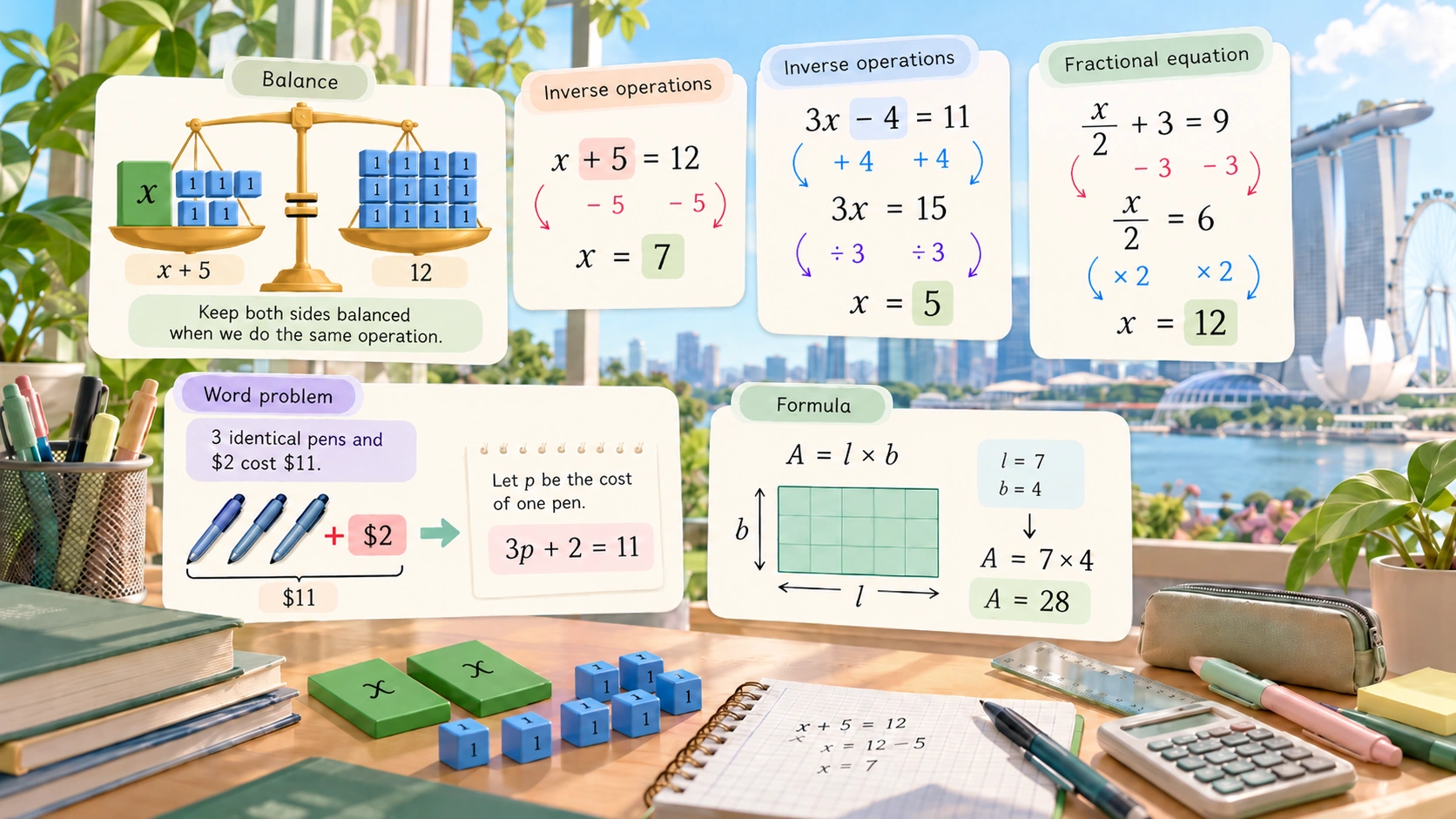
What this chapter trains
Linear equations teach students to keep both sides balanced, isolate the unknown and check whether a solution satisfies the original equation.
Concept of equation
An equation is a mathematical statement that says two expressions have equal value. The equals sign means both sides must balance.
Expression
An expression has no equals sign.
Equation
An equation states that two expressions are equal.
Solution
A solution is a value that makes the equation true.
Solving linear equations
To solve an equation, isolate the unknown on one side. Whatever operation is done to one side must also be done to the other side.
Balance idea
If both sides are equal, adding, subtracting, multiplying or dividing both sides by the same non-zero number keeps the equation balanced.
Worked example
Solve \(3x – 4 = 11\).
Reveal teaching answer
Check: \(3(5)-4=11\).
Fractional coefficients and fractional equations
Equations with fractional coefficients can be solved by clearing denominators. Fractional equations require extra care because the denominator cannot be zero.
Fractional coefficient
Solve \(\frac{x}{2}+3=9\).
Reveal teaching answer
Fractional equation
Solve \(\frac{9}{2x-5}=3\).
Reveal teaching answer
Restriction: \(2x-5 \ne 0\), so \(x \ne \frac{5}{2}\). The solution \(x=4\) is allowed.
Applications of linear equations
Algebra helps solve word problems that are hard to draw using models. The key skill is translating the situation into an equation.
Word problem flow
Three identical pens and a $2 delivery fee cost $11. Let \(p\) be the cost of one pen.
Age problem structure
A man is 3 times as old as his son. In 10 years, their ages add up to 76.
The son is 14 years old now.
Mathematical formulae
A formula shows the relationship between quantities. Students may need to substitute values into a formula or construct a formula from a situation.
Evaluating formulae
Use \(V=lbh\) to find \(V\) when \(l=7\), \(b=4\), \(h=3\).
Reveal teaching answer
Constructing formulae
The sum of four consecutive even numbers can be represented using \(n\), \(n+2\), \(n+4\), \(n+6\).
Common equation traps that cost marks
These are the mistakes students should check before starting the full PDF practice.
If you subtract 5 from the left side, subtract 5 from the right side too.
When moving terms, think of applying inverse operations, not simply “moving across”.
Clear denominators carefully and check restrictions such as \(2x-1 \ne 0\).
Define the unknown clearly before forming an equation.
Substitute values into the correct variables. Do not mix up length, breadth and height.
Substitute the answer back into the original equation, especially for fractional equations.
Quick Self-Check before PDF practice
This short quiz checks whether students are ready for the full Chapter 5 PDF. It focuses on equation traps, not practice volume.
1. Solve \(x+5=12\).
2. Solve \(3x-4=11\).
3. Solve \(\frac{x}{2}+3=9\).
4. In \(\frac{5}{2x+1}\), what restriction must be stated?
5. Use \(V=lbh\). Find \(V\) when \(l=7\), \(b=4\), \(h=3\).
Diagnostic practice questions
These questions are for projection and discussion. Answers are hidden so students can attempt first. Use the PDF for the full classwork and homework set.
Solve \(x-4=9\).
Skill tested: inverse operation.Reveal diagnostic answer
Solve \(2x+3=9\).
Skill tested: two-step equation.Reveal diagnostic answer
Solve \(3x-4=11\).
Skill tested: balancing both sides.Reveal diagnostic answer
Solve \(\frac{x}{3}-2=4\).
Skill tested: fractional coefficient.Reveal diagnostic answer
Solve \(\frac{9}{2x-5}=3\).
Skill tested: fractional equation and restriction.Reveal diagnostic answer
Restriction: \(x \ne \frac{5}{2}\), so \(x=4\) is valid.
Three identical pens and a $2 delivery fee cost $11. Form and solve an equation.
Skill tested: word problem to equation.Reveal diagnostic answer
Let \(p\) be the cost of one pen.
Use \(A=\frac{1}{2}bh\) to find \(A\) when \(b=12\), \(h=9\).
Skill tested: substitution into formula.Reveal diagnostic answer
Find a formula for the sum \(S\) of four consecutive odd numbers, starting with \(n\).
Skill tested: constructing formulae.Reveal diagnostic answer
This can also be simplified to \(S=4n+12\).
Use the PDF for classwork and homework
The webpage is designed for teaching, diagnosis and discussion. The PDF is the main practice asset for students.
Full chapter practice
The PDF covers solving equations, fractional equations, word problems and mathematical formulae.
LaTeX maths
Fractions and equations are typeset properly for a clearer worksheet experience.
Teacher-friendly
Use the page to teach and project. Use the PDF for student attempts and follow-up marking.
How to use this page in class
Suggested lesson flow
What to watch for
Students may apply an operation to only one side of the equation.
Students may lose negative signs when simplifying.
Students may forget restrictions in fractional equations.
Students may form the wrong equation from a word problem.
Students may substitute into the wrong variable in a formula.
Ready for Chapter 5 practice?
Download the PDF for the full worksheet, then use the self-check and diagnostic reveals when you need help with equation-solving traps.
 Stuck? Ask a free tutor