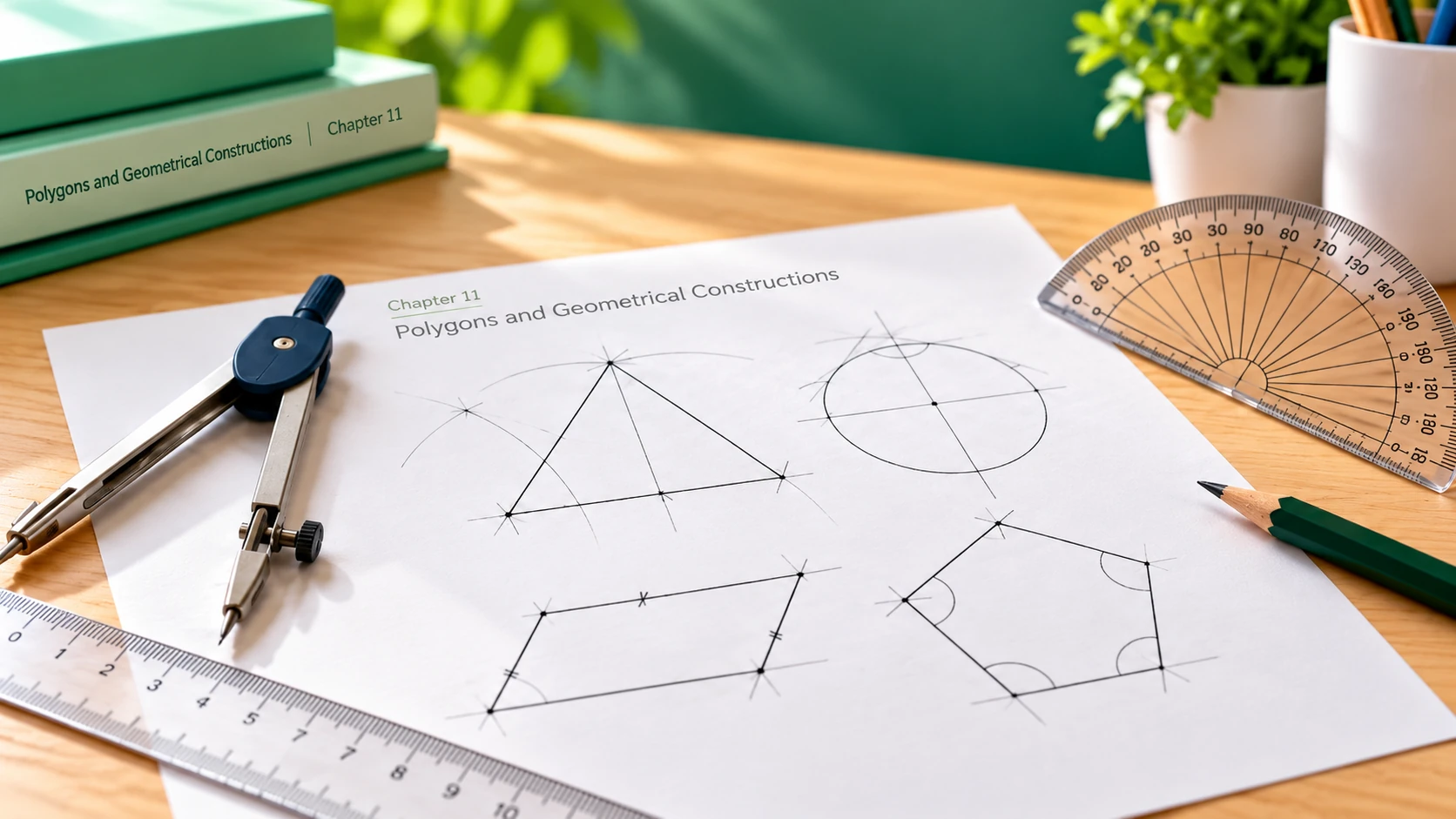
Polygons and Geometrical Constructions
Explore the properties of triangles, quadrilaterals and polygons. Learn to construct geometrical figures accurately using a ruler, protractor and a pair of compasses.
Follow clear diagrams, step-by-step explanations and worked examples to strengthen your geometrical reasoning and problem-solving skills.
Learning goals
By the end of this chapter, students should be able to:
Understand shapes
Classify triangles and quadrilaterals and explain their geometrical properties.
Construct figures
Use mathematical instruments to construct triangles and quadrilaterals accurately.
Reason with polygons
Calculate interior and exterior angles and identify line and rotational symmetry.
1. Understanding triangles
A triangle is a closed figure made up of three straight sides.
A triangle has three vertices and three interior angles. We can classify triangles according to their side lengths or their angles.
A. Classification of triangles
Classification by sides
Equilateral triangle
Three equal sides and three equal angles of 60°.
Isosceles triangle
At least two equal sides. The angles opposite the equal sides are equal.
Scalene triangle
All three sides have different lengths.
Classification by angles
Acute-angled
All three angles are less than 90°.
Right-angled
One angle is exactly 90°.
Obtuse-angled
One angle is greater than 90° but less than 180°.
B. Basic properties of triangles
The lengths of the sides of a triangle are related to the sizes of the opposite angles.
The largest angle is opposite the longest side.
The smallest angle is opposite the shortest side.
Equal sides are opposite equal angles.
Worked example 1
In triangle ABC:
∠A = 43°, ∠B = 79° and ∠C = 58°.
Which side is the longest?
Reveal solution
The largest angle is ∠B = 79°.
The side opposite ∠B is AC.
Therefore, AC is the longest side.
Triangle inequality
The sum of the lengths of any two sides of a triangle must be greater than the length of the third side.
Add the two shorter sides.
Their sum must be greater than the longest side.
Can these lengths form a triangle?
The lengths are 5 cm, 8 cm and 12 cm.
Show reasoning
5 + 8 = 13
Since 13 > 12, the sum of the two shorter sides is greater than the longest side.
Yes, a triangle can be formed.
Lengths of 4 cm, 6 cm and 10 cm cannot form a triangle.
4 + 6 = 10, but the sum must be strictly greater than 10.
C. Angle sum of a triangle
∠A + ∠B + ∠C = 180°
The sum of the interior angles of a triangle is always 180°.
One way to understand this property is to draw a line through one vertex parallel to the opposite side. Using alternate angles, the three interior angles can be arranged along a straight line.
Finding a missing angle
In triangle PQR, ∠P = 38°, ∠Q = 74° and ∠R = x°.
Show step-by-step solution
x + 38° + 74° = 180° (angle sum of triangle)
x = 180° − 38° − 74°
x = 68°
Angles in an isosceles triangle
An isosceles triangle has a vertex angle of 44°. Find each base angle.
Reveal working
Sum of the base angles:
180° − 44° = 136°
Since the base angles are equal:
Each base angle = 136° ÷ 2 = 68°
D. Exterior angles of a triangle
An exterior angle is formed when one side of a triangle is extended.
Exterior angle property
An exterior angle of a triangle is equal to the sum of its two interior opposite angles.
∠CBD = ∠BAC + ∠ACB
In triangle ABC, side AB is extended beyond B to D.
Given ∠BAC = 53° and ∠ACB = 67°, find ∠CBD.
Reveal solution
∠CBD = ∠BAC + ∠ACB (exterior angle of triangle)
= 53° + 67°
∠CBD = 120°
An exterior angle is 128°. One interior opposite angle is 47°.
Find the other interior opposite angle and the adjacent interior angle.
Show both steps
Other interior opposite angle:
128° − 47° = 81°
Adjacent interior angle:
180° − 128° = 52°
Classify triangles correctly, apply the triangle inequality, use the angle sum of 180°, and explain exterior-angle calculations using the correct geometrical property.
2. Understanding quadrilaterals
A quadrilateral is a closed figure with four straight sides, four vertices and four interior angles.
A diagonal joins two non-adjacent vertices.
A. Angle sum of a quadrilateral
Drawing one diagonal divides a simple quadrilateral into two triangles.
Why 360°?
Each triangle has an interior angle sum of 180°.
180° + 180° = 360°
∠A + ∠B + ∠C + ∠D = 360°
Three interior angles of a quadrilateral are 85°, 104° and 96°. Find the fourth angle x.
Show working
x + 85° + 104° + 96° = 360°
x = 360° − 85° − 104° − 96°
x = 75°
B. Properties of special quadrilaterals
Special quadrilaterals can be identified using their sides, interior angles and diagonals.
Parallelogram
Two pairs of opposite sides are parallel and equal.
Opposite angles are equal. Diagonals bisect each other.
Rectangle
Four right angles. Opposite sides are equal.
Diagonals are equal and bisect each other.
Square
Four equal sides and four right angles.
Diagonals are equal, perpendicular and bisect each other.
Rhombus
Four equal sides. Opposite angles are equal.
Diagonals bisect each other at right angles and bisect the interior angles.
Trapezium
Has at least one pair of parallel sides.
Interior angles on the same side of a transversal sum to 180°.
Kite
At least two pairs of equal adjacent sides.
The diagonals are perpendicular. One diagonal bisects the other.
This chapter uses an inclusive definition of a trapezium: at least one pair of parallel sides.
Therefore, a parallelogram is also a special type of trapezium.
Under the textbook’s inclusive definition of a kite, a rhombus is also a special type of kite.
Comparing diagonal properties
| Shape | Diagonals |
|---|---|
| Parallelogram | Bisect each other |
| Rectangle | Equal and bisect each other |
| Square | Equal, perpendicular, bisect each other and bisect interior angles |
| Rhombus | Perpendicular, bisect each other and bisect interior angles |
| Kite | Perpendicular; the diagonal joining the vertices where equal sides meet bisects the other diagonal |
Angles in a parallelogram
ABCD is a parallelogram. Given ∠DAB = 68°, find ∠ABC and ∠BCD.
Reveal working
∠ABC = 180° − 68°
= 112° (adjacent angles of a parallelogram)
∠BCD = ∠DAB = 68° (opposite angles of a parallelogram)
Diagonals in a rectangle
ABCD is a rectangle. Its diagonals AC and BD intersect at E.
Given CE = 4 cm, find AC, BD and BE.
Show solution
AC = 2 × 4 = 8 cm (diagonals bisect each other)
BD = AC = 8 cm (diagonals of rectangle are equal)
BE = BD ÷ 2 = 4 cm
Angles in a rhombus
ABCD is a rhombus. ∠ABC = 124°. Diagonal BD bisects ∠ABC.
Find ∠ABD and ∠BCD.
Show reasoning
∠ABD = 124° ÷ 2 = 62°
∠BCD = 180° − 124° = 56°
Reasons: the diagonal of a rhombus bisects its interior angles, and adjacent angles of a parallelogram are supplementary.
Identify the quadrilateral first, then choose the correct property.
State reasons such as opposite angles of a parallelogram, diagonals of a rectangle, or interior angles between parallel lines.
3. Constructing triangles and quadrilaterals
A geometrical construction must satisfy the given lengths and angles.
Students should use a ruler, a protractor and a pair of compasses.
A. Introduction to geometrical constructions
Ruler
Draws straight lines and measures lengths.
Protractor
Measures and constructs angles accurately.
Compasses
Draw circles and arcs and transfer distances without changing the opening.
- Use a sharp pencil.
- Draw thin, accurate lines.
- Keep construction arcs visible.
- Label all required vertices.
- Check the final measurements.
B. Construction of triangles
Case 1 — One side and two angles
Construct triangle XYZ with:
XY = 7 cm, ∠YXZ = 55°, ∠XYZ = 65°.
- Draw XY = 7 cm.
- At X, draw a ray making 55° with XY.
- At Y, draw a ray making 65° with YX, on the same side of XY.
- Label the intersection of the two rays Z.
- Complete triangle XYZ.
Find the third angle
∠XZY = 180° − 55° − 65°
∠XZY = 60°
Case 2 — Three sides
Illustration of the compass-arc method. The required lengths are stated in the construction question.
Worked example 11
Construct triangle PQR with:
PQ = 7 cm, PR = 6 cm, QR = 5 cm.
- Draw PQ = 7 cm.
- Draw an arc with centre P and radius 6 cm.
- Draw another arc with centre Q and radius 5 cm.
- Label one intersection R.
- Join PR and QR.
The intersection R is 6 cm from P and 5 cm from Q.
Therefore, all three side lengths are fixed.
Case 3 — Two sides and one angle
When the given angle is between the two known sides, the construction determines one triangle shape and size, apart from reflection.
Construct triangle ABC with:
AB = 8 cm, AC = 5 cm, ∠BAC = 55°.
- Draw AB = 8 cm.
- At A, construct a ray making 55° with AB.
- Use compasses to mark C on the ray so that AC = 5 cm.
- Join BC.
When two triangles are possible
When the given angle is not between the two known sides, more than one triangle may satisfy the measurements.
Worked example 13
Given:
AB = 8 cm, BC = 5 cm, ∠BAC = 30°.
Construct the 30° ray from A.
Draw an arc with centre B and radius 5 cm.
The arc intersects the ray at two positions: C₁ and C₂.
Two sides and a non-included angle can produce zero, one or two possible triangles.
Always check the construction rather than assuming uniqueness.
C. Construction of quadrilaterals
To construct a quadrilateral, we combine the given measurements with known properties of the shape.
Constructing a parallelogram
Construct parallelogram ABCD with:
AB = 8 cm, BC = 5 cm, ∠ABC = 65°.
- Draw AB = 8 cm.
- At B, construct a 65° angle from BA.
- Mark C on the new ray such that BC = 5 cm.
- With A as centre, draw an arc of radius 5 cm.
- With C as centre, draw an arc of radius 8 cm.
- Label their intersection on the opposite side of AC from B as D.
- Join AD and CD.
Check that AB = CD, BC = AD and opposite sides are parallel.
Why are four side lengths sometimes insufficient?
Knowing the lengths of four sides does not usually determine a unique general quadrilateral.
Its angles can change while all four side lengths remain unchanged.
What additional information helps?
A suitable angle or diagonal may be needed to determine the intended shape.
Use appropriate mathematical instruments, preserve construction arcs, label every vertex and verify the completed figure.
Explore triangle construction
A triangle can be constructed from three side lengths only when those lengths satisfy the triangle inequality.
Change BC while AB and AC remain fixed.
Construction arcs are shown. The drawing is a scaled mathematical model; use physical instruments for paper constructions.
Change one side length
AB = 7 cm
AC = 6 cm
4. Understanding polygons
A. What are polygons?
A polygon is a closed plane figure formed by straight line segments, with consecutive sides joining at vertices and no three consecutive vertices collinear.
In this section we focus on simple convex polygons.
A simple polygon does not have sides crossing one another.
A convex polygon has all its interior angles less than 180°.
| Number of sides | Name |
|---|---|
| 3 | Triangle |
| 4 | Quadrilateral |
| 5 | Pentagon |
| 6 | Hexagon |
| 7 | Heptagon |
| 8 | Octagon |
| 9 | Nonagon |
| 10 | Decagon |
B. Regular polygons
A regular polygon has all sides equal in length and all interior angles equal.
Both conditions are required.
Regular pentagon
Five equal sides and five equal angles.
Non-regular polygon
Its sides or interior angles are not all equal.
Equal side lengths alone do not always make a polygon regular.
Its interior angles must also be equal.
C. Sum of interior angles
A convex polygon with n sides can be divided into (n − 2) triangles by drawing diagonals from one vertex.
Each triangle has an interior angle sum of 180°.
S = (n − 2) × 180°
where n is the number of sides.
Interior angle sum of a heptagon
Find the sum of the interior angles of a seven-sided polygon.
Show working
S = (n − 2) × 180°
= (7 − 2) × 180°
S = 900°
Interior angle of a regular polygon
In a regular polygon, every interior angle is equal.
Each interior angle = [(n − 2) × 180°] ÷ n
Regular decagon
Find each interior angle of a regular decagon.
Reveal solution
n = 10
Sum = (10 − 2) × 180°
= 1440°
Each interior angle = 1440° ÷ 10
144°
D. Sum of exterior angles
An exterior angle of a polygon is formed by extending one side beyond a vertex.
For a convex polygon, choose one exterior angle at each vertex, all in the same direction.
Sum of exterior angles = 360°
This holds for every convex polygon.
Exterior angle of a regular polygon
Since the exterior angles of a regular polygon are equal:
Each exterior angle = 360° ÷ n
Number of sides = 360° ÷ exterior angle
Finding the number of sides
Each exterior angle of a regular polygon is 24°.
Find its number of sides.
Reveal working
n = 360° ÷ 24°
n = 15
The polygon has 15 sides.
Using interior and exterior angles
Each interior angle of a regular polygon is 162°.
Find the number of sides.
Show both steps
Exterior angle = 180° − 162°
= 18°
n = 360° ÷ 18°
n = 20
E. Line symmetry
A line of symmetry divides a figure into two matching halves.
If the figure is folded along this line, one half fits exactly over the other.
A regular polygon with n sides has n lines of symmetry.
F. Rotational symmetry
A figure has rotational symmetry when it fits exactly onto itself during a rotation of less than 360°.
The order of rotational symmetry is the number of times a figure fits onto itself during one complete turn, counting the final 360° position.
Order of rotational symmetry = n
Smallest angle of rotation = 360° ÷ n
| Regular polygon | Lines of symmetry | Rotational order |
|---|---|---|
| Equilateral triangle | 3 | 3 |
| Square | 4 | 4 |
| Regular pentagon | 5 | 5 |
| Regular hexagon | 6 | 6 |
| Regular octagon | 8 | 8 |
Line symmetry and rotational symmetry are different properties.
A non-square rectangle has two lines of symmetry and rotational symmetry of order 2.
Explore regular polygons
Change the number of sides and observe how the interior angles, exterior angles and symmetry change.
Dashed lines divide the polygon into triangles.
Adjust the polygon
Select five sides, then six sides, then eight sides.
Notice that the sum of interior angles increases, but the sum of exterior angles remains 360°.
Why does the exterior angle of a regular polygon become smaller as the number of sides increases?
Check your understanding
Choose one answer for each question. Then select Check answers to reveal the explanations.
1. Each interior angle of an equilateral triangle is:
An equilateral triangle has three equal angles. 180° ÷ 3 = 60°.
2. Can lengths of 3 cm, 4 cm and 8 cm form a triangle?
3 + 4 = 7, which is less than 8. The triangle inequality is not satisfied.
3. Two interior opposite angles of a triangle are 35° and 65°. Find the corresponding exterior angle.
Exterior angle = 35° + 65° = 100°.
4. The sum of the interior angles of a quadrilateral is:
A quadrilateral can be divided into two triangles. 180° + 180° = 360°.
5. The diagonals of a rectangle are:
The diagonals of a rectangle are equal and bisect each other. They are not generally perpendicular.
6. When constructing a triangle using two sides and a non-included angle, how many different triangle shapes may be possible?
The compass arc may have zero, one or two intersections with the required ray.
7. Find the sum of interior angles of a heptagon.
(7 − 2) × 180° = 5 × 180° = 900°.
8. Each exterior angle of a regular nonagon is:
A nonagon has nine sides. 360° ÷ 9 = 40°.
9. What is the order of rotational symmetry of a regular octagon?
A regular octagon has rotational symmetry of order 8.
Chapter 11 practice PDFs
Use the classroom lessons for explanations and worked examples, then strengthen your understanding with the two printable resources.
PDF 1 — Learning and Practice Workbook
A 23-page textbook-style workbook covering all four Chapter 11 sections.
Includes teaching notes, worked examples, geometrical diagrams, guided practice and answers.
PDF 2 — Supplementary Practice with Solutions
A 10-page supplementary practice resource with 16 additional questions.
Includes additional triangle, quadrilateral, construction and polygon questions, with worked solutions at the back of the same PDF.